
How to Prevent Canker Sores: A Cornelius Dentist’s Guide
June 9, 2026
A Test for TMJ: Your Guide in Cornelius, NC
June 11, 2026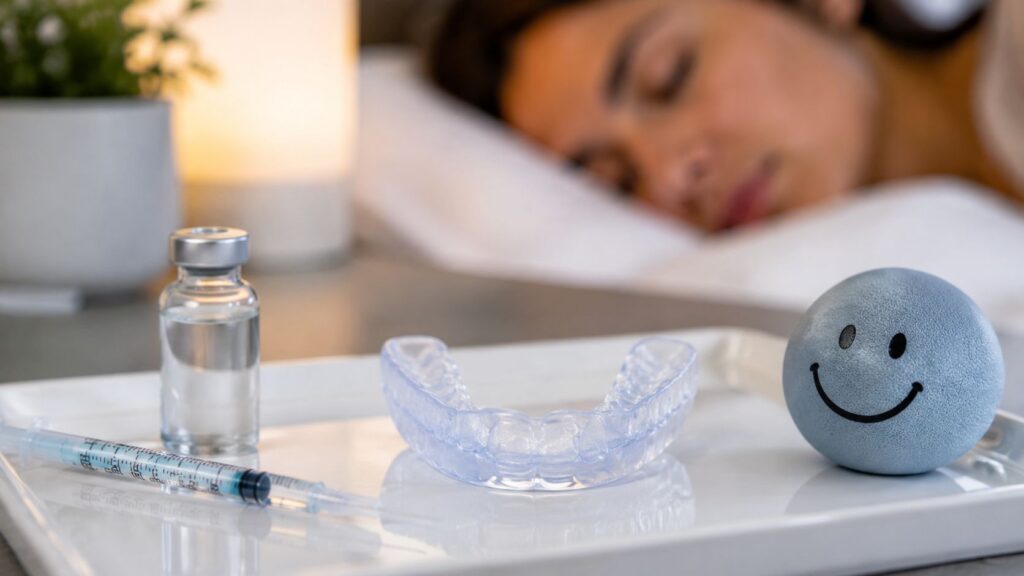
Waking up with a sore jaw, a dull morning headache, or teeth that suddenly feel more sensitive can be unsettling. Sometimes a bed partner hears grinding at night before you notice anything yourself. Other people only realize something is wrong when a dentist points out worn enamel, tiny chips, or tight jaw muscles during an exam.
If that sounds familiar, you're not overreacting. Teeth grinding, also called bruxism, is common, and it can affect more than your teeth. It can strain your jaw joints, irritate facial muscles, and leave you tired of starting the day in discomfort. The encouraging part is that there are several teeth grinding treatment options, and the right one depends on why you're grinding and what kind of damage or symptoms you already have.
For patients searching for a dentist near me in Cornelius, NC, it helps to have a clear explanation before making that first appointment. This guide is meant to answer the questions people usually ask in the office: Is a night guard enough? Is stress causing this? Could it be related to sleep apnea? And when does treatment need to go beyond a simple guard?
Your Trusted Local Dentist for Teeth Grinding in Cornelius NC
You might be reading this after another restless night, rubbing the side of your face and wondering why your jaw feels tight again. You may have tried changing your pillow, taking pain relievers, or ignoring it and hoping it would pass. Teeth grinding usually doesn't improve just because you wait it out.
In Cornelius, many patients start by searching for a dentist near me in Cornelius, NC because they want answers close to home. That's a good instinct. Bruxism is easier to manage when someone checks for the early signs before grinding leads to cracked fillings, worn teeth, or ongoing jaw pain.
A simple comparison helps individuals sort through the choices before they come in.
| Treatment approach | What it mainly does | When it may help most | Important limitation |
|---|---|---|---|
| Behavioral changes | Reduces triggers like stress and poor sleep habits | Mild symptoms, daytime clenching, support for any treatment plan | Takes consistency and may not be enough alone |
| Custom night guard | Protects teeth from wear and cushions biting forces | Night grinding and clenching | Protects teeth, but doesn't necessarily stop grinding itself |
| Bite evaluation and dental adjustments | Identifies whether your bite or existing dental work is adding strain | Uneven pressure, sore muscles, damaged restorations | Only appropriate for selected cases |
| Botox | Weakens jaw muscle contractions in severe cases | Strong clenching force and muscle pain when conservative care hasn't helped | Symptom control, not a cure |
| Sleep evaluation | Looks for airway or sleep-disordered breathing issues | Grinding with snoring, fatigue, or waking unrefreshed | Requires a broader workup beyond a standard dental exam |
At Dr. Skotzko Family and Cosmetic Dentistry, the conversation starts with what's happening to you, not with a one-size-fits-all appliance. Some patients need protection for their teeth right away. Others need a closer look at stress habits, jaw strain, or sleep problems that may be sitting underneath the grinding.
Practical rule: If you're waking up sore, seeing tooth wear, or hearing from a partner that you grind at night, it's worth getting checked before the damage gets harder to repair.
Understanding Bruxism Signs Symptoms and Diagnosis
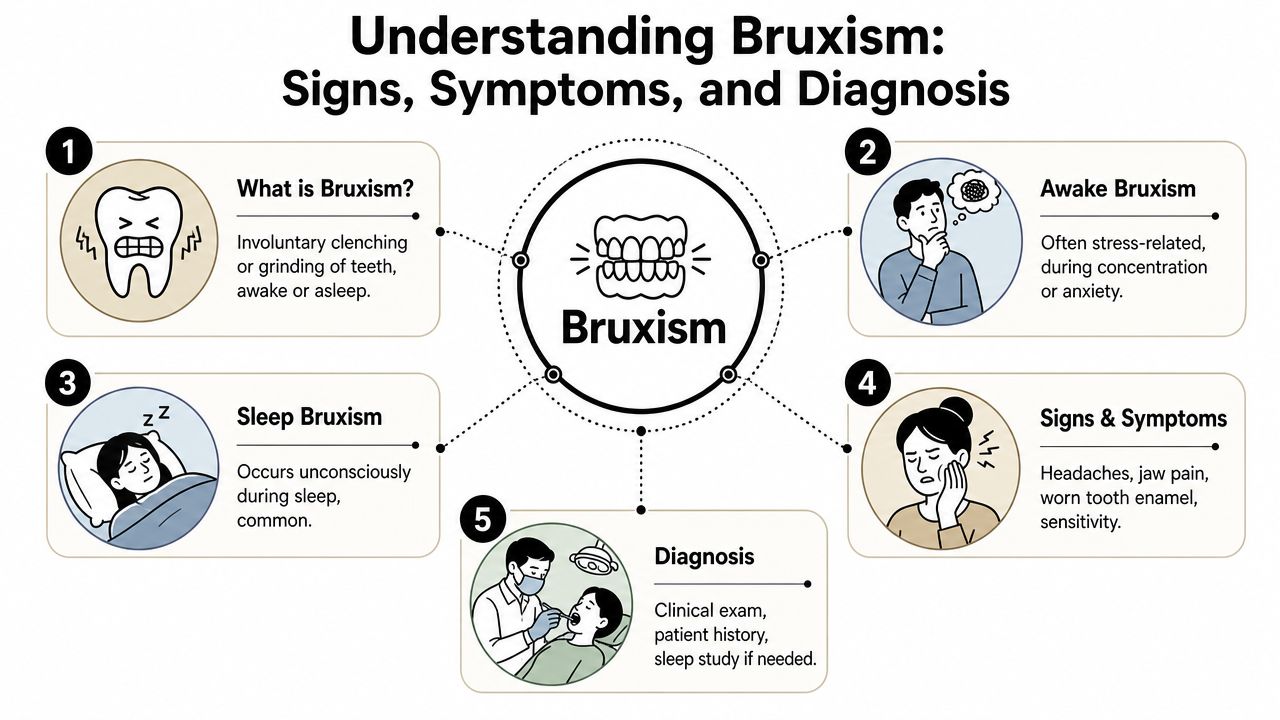
Bruxism means clenching or grinding your teeth, and it can happen when you're awake or asleep. Those two patterns matter because they don't always feel the same.
Awake bruxism often shows up during concentration, stress, or tension. You may catch yourself pressing your teeth together while driving, working, or answering emails. Sleep bruxism happens unconsciously, so many people only learn about it after symptoms build up or someone hears the grinding.
What patients usually notice first
The first signs are often easy to dismiss. A tight jaw can feel like stress. A headache can feel unrelated. Sensitive teeth can seem like a cavity.
Common clues include:
- Morning jaw soreness that fades as the day goes on
- Headaches around the temples or facial tightness
- Tooth sensitivity from enamel wear
- Flattened, chipped, or worn teeth
- Neck or jaw muscle fatigue
- Clicking or discomfort around the jaw joint
- Grinding noises at night noticed by a partner
Some people also notice they can't fully relax their jaw during the day. Their lips are closed, but their teeth are still touching. That constant pressure can tire the muscles even without obvious grinding.
How a dentist diagnoses it
Diagnosis usually starts with a conversation and a close exam. A dentist looks for a pattern, not just one symptom. Worn chewing edges, small fractures, matching wear marks, cheek or tongue impressions, and tender jaw muscles can all point toward bruxism.
Your history matters just as much as the exam. If you wake with soreness, catch yourself clenching during the day, or your partner hears grinding, those details help connect the dots.
A visit may also include checking the jaw joints, evaluating how your teeth come together, and looking at existing dental work. Fillings, crowns, and veneers can sometimes show wear patterns that reveal how much force your bite is absorbing.
Some grinding is loud and obvious. Some is silent clenching. Both can stress teeth and jaw muscles.
Why early diagnosis matters
Untreated bruxism can gradually wear down enamel, increase sensitivity, damage dental work, and aggravate jaw discomfort. The confusing part is that the damage may build slowly while the symptoms come and go.
That's why patients often say, “I thought it was just stress,” until a cracked tooth or persistent soreness forces the issue. Catching it earlier usually means more conservative treatment options and fewer repairs later.
Conservative and Behavioral Treatment Approaches
Many people assume the answer has to be a device. Sometimes it is. But the foundation of bruxism care often starts with daily habits that lower muscle tension and reduce triggers.
Clinical guidance now includes behavioral therapy, sleep hygiene, and oral appliances as evidence-based treatment options. Healthdirect recommends counseling, including cognitive behavioural therapy, relaxation techniques such as mindfulness and meditation, and better sleep habits, while also advising people to avoid caffeine and other stimulants in the evening on its teeth grinding guidance. That matters because bruxism isn't always just a tooth problem. Stress, anxiety, and sleep quality can all feed into it.
When behavior changes make a real difference
If you grind mostly when you're awake, habit awareness can be powerful. Many people don't realize how often they're clenching until they start checking in with themselves during the day.
A useful reset is simple: lips together, teeth apart, tongue resting lightly up behind the front teeth. That posture gives your jaw muscles a break.
Behavioral treatment can include:
- Stress support through counseling or cognitive behavioural therapy when tension is a clear trigger
- Relaxation habits like mindfulness, breathing exercises, or meditation before bed
- Sleep hygiene such as a steadier sleep schedule and a calmer bedtime routine
- Evening stimulant reduction by cutting back on caffeine later in the day
Mayo Clinic also lists practical steps such as reducing stress, avoiding caffeine and alcohol at night, not smoking, and keeping up with regular dental exams on its bruxism treatment page.
Small changes that reduce jaw strain
Patients often ask what they can do today, before any custom appliance is made. Start with the habits that remove extra load from your jaw.
- Stop “testing” sore teeth. If you keep tapping a sensitive tooth together to see if it still hurts, you keep feeding the irritated muscles and ligaments.
- Avoid chew-heavy habits. Gum chewing, ice crunching, nail biting, and pen chewing all keep jaw muscles activated.
- Use a softer food approach during flare-ups. If your jaw is angry, steak and chewy bagels won't help it settle down.
- Warm compresses can be soothing. They won't fix the cause, but they may calm tight muscles enough to make evenings easier.
Why conservative care isn't just optional add-on advice
These approaches work best when you treat them as part of the treatment, not as background wellness tips. A custom guard can protect teeth at night, but if you spend the whole day clenching at your desk, the muscles never fully recover.
That's why the most effective care is often layered. One part protects the teeth. Another reduces the forces you're putting through the system. Another looks at whether stress or sleep issues are keeping the cycle going.
Why a Custom Dental Night Guard Is the Gold Standard
When patients hear “night guard,” they often think every guard does basically the same thing. In practice, the fit changes everything.
For sleep bruxism, the best-supported first-line mechanical option is a custom-fitted hard acrylic occlusal guard. StatPearls notes that oral devices are meant to prevent further tooth damage, even though current data show they do not reduce the frequency of bruxism in sleep bruxism, in its clinical overview of bruxism. That's an important distinction. A guard is mainly there to protect your teeth and reduce strain, not to “cure” the underlying grinding.
What a night guard actually does
A properly made guard creates separation between the upper and lower teeth. That barrier helps limit enamel wear, reduces the chance of cracks or fractures, and can lessen morning jaw discomfort by changing how force is distributed during sleep.
Think of it less like a switch that turns grinding off and more like a shield. If you still clench, your teeth aren't taking the full hit directly against each other.
USC's Ostrow School notes, as summarized in the verified guidance, that a full-arch, well adjusted, and balanced contact pattern occlusal appliance is the “single most effective” way to protect teeth from sleep bruxism. That language helps explain why professionally made appliances have become the preferred approach.
OTC guard versus custom-fitted guard
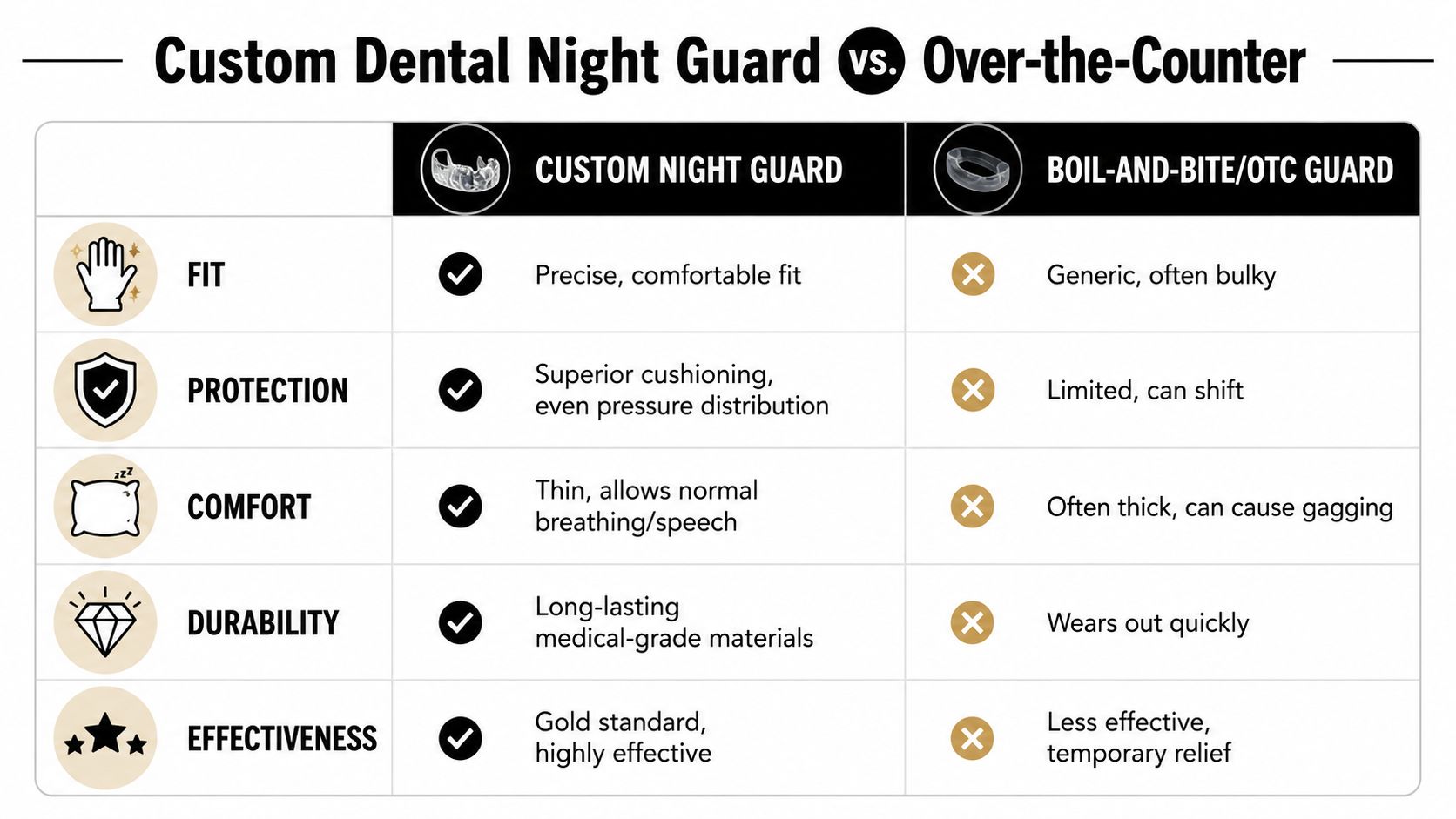
The big difference is precision. Store-bought boil-and-bite guards are generic. A custom guard is designed around your actual bite.
Here is the practical comparison most patients care about.
| Feature | Over-the-Counter OTC Guard | Custom-Fitted Guard from Skotzko Family Dental |
|---|---|---|
| Fit | Generic fit, even after molding | Made for your teeth and bite |
| Comfort | Can feel bulky or loose | Usually feels more stable and easier to wear |
| Protection | Basic barrier | More precise contact and force distribution |
| Jaw position | Less controlled | Better adjusted to avoid uneven pressure |
| Durability | Often wears down faster | Typically more durable material |
| Follow-up | Usually no professional review | Can be checked and refined if needed |
A poor fit doesn't just feel annoying. It can lead to uneven contact, more bulk, gagging, or a guard that gets left on the nightstand instead of worn.
Why dentist-made appliances have become the preferred option
Evidence summarized in Healthdirect and StatPearls shows the best appliance is often a custom-fitted occlusal splint or hard-acrylic bite guard fitted by a dental clinician, because precision fit improves protection and comfort. You can see that shift reflected in preventive dental care options that focus on protecting teeth before bigger damage occurs.
A custom appliance also gives your dentist something an OTC guard can't provide. It creates a chance to evaluate the whole bite, the wear pattern, and whether the appliance needs adjustment after you start using it.
A night guard should feel like part of a treatment plan, not a random plastic product you hope will work.
The confusion patients often have
Patients sometimes feel disappointed when they hear that even a very good guard may not stop grinding events. That's understandable. But it doesn't mean the guard isn't working.
If your teeth are no longer wearing against each other, if small fractures are less likely, and if your jaw is less sore in the morning, that's meaningful progress. In bruxism treatment, protection matters. Preventing further damage matters.
Custom guards aren't the answer for every single case, but for night grinding they're often the anchor treatment around which the rest of the plan is built.
Advanced Treatments Occlusal Adjustments and Botox
Some people reach a point where the usual first steps are not enough. They are wearing a custom guard, trying to reduce daytime clenching, and still waking up with sore jaw muscles or seeing repeated damage to teeth, fillings, or crowns. In those cases, treatment may need to address the force pattern, the bite contacts, or the jaw muscles themselves.
It helps to sort these options by what problem they are meant to solve.
Occlusal adjustments and bite-focused care
An occlusal adjustment is a careful reshaping of small contact points so the teeth come together more evenly. A simple way to picture it is a table with one leg slightly too long. The whole table is not defective, but that one pressure point keeps taking the load. In the mouth, a high spot on a tooth or restoration can do something similar by attracting excess force over and over.
That does not mean bruxism is always caused by a "bad bite." It often is not. Stress, sleep patterns, and airway issues can all play a role. But if an exam shows one crown is hitting early, one tooth is overloaded, or a restoration is taking repeated impact, a bite adjustment or refinement may reduce that local strain.
Sometimes the answer is not shaving enamel. It may be polishing or adjusting a crown, replacing a restoration that is too high, or considering orthodontic treatment if alignment is concentrating force in the wrong places. The right choice depends on what your dentist sees during the exam.
Botox for severe muscle-driven clenching
Botox is used in some severe cases where the main problem is muscle force, especially in the larger chewing muscles. It works like turning down the power on an overactive motor. The muscles can still function, but they may contract less aggressively.
Patients usually ask a very reasonable question. Will Botox stop the grinding itself?
The honest answer is that Botox is generally used to reduce muscle intensity and discomfort, not to cure the habit or eliminate every grinding episode. That is why it is usually considered part of a larger plan rather than a standalone fix. Mayo Clinic's bruxism treatment guidance and the clinical overview in StatPearls on bruxism both reflect that broader view.
A guard may still be needed to protect the teeth. Botox may help if the clenching force is so strong that muscles stay sore or dental work keeps taking a beating. Those are different jobs.
Choosing the right advanced option
Advanced treatment is really a matching process.
- If one or two teeth are taking too much pressure, bite adjustment or restorative refinement may help.
- If the jaw muscles are overworking, Botox may be considered to reduce force.
- If damage is widespread, more than one approach may be appropriate at the same time.
Good treatment planning starts with the cause, not just the symptom. A patient who grinds because of stress may need a different plan than a patient whose grinding is tied to sleep disruption or possible airway problems. That whole-health view matters because it keeps treatment from becoming too narrow.
If your symptoms are persistent, or the damage keeps returning, this is a good point to have a detailed exam with a dentist in Cornelius who can sort out what is driving the problem and which option best fits your case.
Investigating Underlying Causes Like Sleep Apnea
Many online guides often stop too soon. They explain guards and stress, but they don't always ask whether night grinding is tied to a sleep-breathing problem.
A critical but often overlooked question is when teeth grinding is a symptom of sleep-disordered breathing. Persistent night grinding, especially when paired with snoring or daytime sleepiness, can point toward that possibility. In those situations, a standard night guard may only protect the teeth without addressing the underlying airway issue, and treatments like mandibular advancement devices or sleep apnea therapy may be more appropriate, as noted in Sleep Foundation's tips for bruxism and related sleep issues.

Clues that suggest the problem may be bigger than grinding
If you grind your teeth and also have signs of poor breathing during sleep, that changes the conversation. Watch for combinations like these:
- Snoring plus grinding
- Daytime sleepiness plus morning jaw pain
- Waking unrefreshed even after enough hours in bed
- Dry mouth on waking
- A partner noticing pauses, choking, or restless sleep
That doesn't automatically mean you have sleep apnea. It does mean the dentist should consider whether grinding is part of a larger sleep pattern rather than an isolated jaw habit.
Why this changes treatment
A regular night guard can still be helpful for protecting teeth. But if the body is repeatedly reacting to airway stress during sleep, tooth protection alone may not get to the root of the problem.
In selected patients, a mandibular advancement device may be part of the discussion. That appliance approach is different from a basic protective guard because it is designed to help with airway support in appropriate cases. Some patients may also need a referral for further sleep evaluation.
If you grind, snore, and feel exhausted during the day, ask whether the issue could involve your airway and not just your bite.
The whole-health view patients appreciate
This broader look is often the moment when patients feel relieved. They realize the goal isn't merely to hand them a guard and send them home. The goal is to ask better questions.
That matters because lasting relief often comes from treating the reason a symptom is happening, not just shielding the teeth from the symptom itself.
Your Treatment Journey at Skotzko Family Dental Clinic
For many people, the hardest part is not the treatment. It's making the first call because they aren't sure what to expect. A clear process takes a lot of the stress out of it.

What the first visit usually feels like
A typical visit starts with your symptoms. Maybe it's jaw soreness, headaches, sensitive teeth, cracked dental work, or a spouse hearing grinding at night. Those details matter because they help separate daytime clenching, nighttime grinding, and possible sleep-related concerns.
From there, the exam focuses on patterns. The dentist may look for worn enamel, stress on restorations, bite marks, muscle tenderness, jaw joint function, and signs that suggest your teeth are taking more force than they should. If needed, diagnostic images may be part of the workup to rule out other problems and understand the condition of the teeth and supporting structures.
The next step is a conversation, not a script. If your symptoms look mild and stress-related, the plan may focus first on habit changes and protective care. If your tooth wear is more advanced, a custom appliance may make sense sooner. If your history raises concern about breathing during sleep, that should shape the recommendation too.
How treatment decisions get personalized
Two patients can both say, “I grind my teeth,” and need different care.
One patient may mainly need:
- Awareness training for daytime clenching
- Sleep routine changes
- Monitoring to make sure wear isn't progressing
Another patient may need:
- A custom hard acrylic guard
- Adjustment of a high dental contact
- Evaluation for airway-related sleep issues
Later in the process, if you're curious what the office experience is like, this short video gives a helpful feel for the practice environment and philosophy.
What patients usually want most
Patients often don't come in asking for a specific appliance or procedure. They want three things.
- A clear explanation of what's causing the pain or wear
- A practical plan that fits their life and symptoms
- Reassurance that they caught it in time or can still get it under control
That patient-centered approach matters for families in Cornelius, as well as nearby patients from Huntersville and Davidson who want care that feels predictable and calm. Teeth grinding can sound complicated online. In person, it usually becomes much easier to understand once someone shows you where the pressure is landing and why the symptoms keep repeating.
Schedule Your Consultation in Cornelius Today
Teeth grinding can be easy to minimize because it often happens in the background. You may tell yourself it's only stress, only occasional, or only a little jaw tension in the morning. But repeated grinding and clenching can wear teeth down, aggravate sensitivity, strain the jaw, and put pressure on existing dental work.
The good news is that you have options. Some patients improve with behavioral changes and better sleep habits. Others need the protection of a custom night guard. Some need a closer look at their bite. A smaller group may need evaluation for sleep-related breathing problems when grinding comes with snoring or daytime fatigue.
What matters most is getting the right diagnosis before choosing the treatment. A guard can be helpful, but only if it matches the underlying problem. If the issue includes stress habits, muscle overload, or possible airway concerns, the treatment plan should reflect that.
If you're in Cornelius, NC, and you've been waking up with jaw pain, morning headaches, tooth sensitivity, or concerns about grinding at night, now is a good time to get it checked. The earlier bruxism is identified, the easier it usually is to protect your teeth and calm the cycle before more damage develops.
You don't need to figure it all out on your own first. A consultation can help answer simple but important questions. Are you clenching during the day? Grinding at night? Wearing your teeth down? Or dealing with something that points beyond the teeth alone?
If you're ready to talk through your symptoms, request a visit with Skotzko Family Dental Clinic. A consultation can help you understand what's causing the grinding, what your treatment options are, and what next step makes the most sense for you in Cornelius.