
What to Eat with Canker Sores: Soothe & Heal Fast
June 8, 2026
You notice it when you take the first sip of coffee, bite into a sandwich, or brush your teeth before bed. One small sore inside the cheek or lip suddenly makes the whole day feel irritating. If you get them over and over, it's easy to wonder what you're doing wrong.
The good news is that recurring canker sores usually aren't about poor hygiene or bad luck alone. In many cases, they follow a pattern. When patients in Cornelius come in frustrated by repeat outbreaks, the most helpful shift is moving away from searching for one miracle rinse and toward building a personal prevention plan.
A Local Dentist's Approach to Canker Sore Prevention
A canker sore often feels minor until it affects eating, talking, and brushing. Then it becomes the only thing you can think about. Many people try the same cycle every time. Wait a few days, rinse with whatever is in the medicine cabinet, avoid spicy foods for a bit, then hope it doesn't come back.
That approach can help with comfort, but it usually misses the bigger issue. Prevention is rarely one-size-fits-all. One person keeps getting sores after accidentally biting the inside of the cheek. Another flares up after acidic foods. Someone else notices a pattern during stressful weeks or after using a certain toothpaste.
In practice, the most useful conversations happen when we stop asking, “What product fixes this?” and start asking, “What keeps setting this off?” That small change matters. It turns canker sore prevention into something practical and manageable.
Why a personalized plan works better
Canker sores are common, but the exact cause still isn't fully clear. A JAMA review on canker sores notes that they affect an estimated 39% to 50% of people over a lifetime, with first onset typically between ages 10 and 19. The same review explains why prevention advice is so individualized. There's no surefire prevention method, so care focuses on avoiding personal triggers and checking for nutrient issues such as vitamin B12, folic acid, iron, and zinc.
Practical rule: If your sores keep coming back, don't judge the problem by the sore itself. Judge it by the pattern around it.
For families in Cornelius, that usually means paying attention to habits that seem harmless. Brushing too hard. Eating quickly. A rough edge on an appliance. A favorite salty snack. Stress that shows up in the mouth before it shows up anywhere else.
What a dentist looks for
A local family dentist doesn't just look at the ulcer. We look at the setting around it.
That includes questions like these:
Where does it appear most often
The same spot may point to friction or repeated injury.What happened in the day or two before it showed up
Food, stress, trauma, and oral care products can all matter.How often does it recur
Frequency helps guide whether simple trigger control is enough or whether deeper evaluation makes sense.
A thoughtful prevention plan doesn't promise perfection. It gives you a clearer way to reduce flare-ups and respond earlier when patterns show up.
Understanding Your Personal Canker Sore Triggers
The fastest way to prevent canker sores is to become observant. Not anxious. Just observant. Most recurrent sores have clues around them, and those clues are often easy to miss when you're focused on pain relief.
The trigger categories that matter most
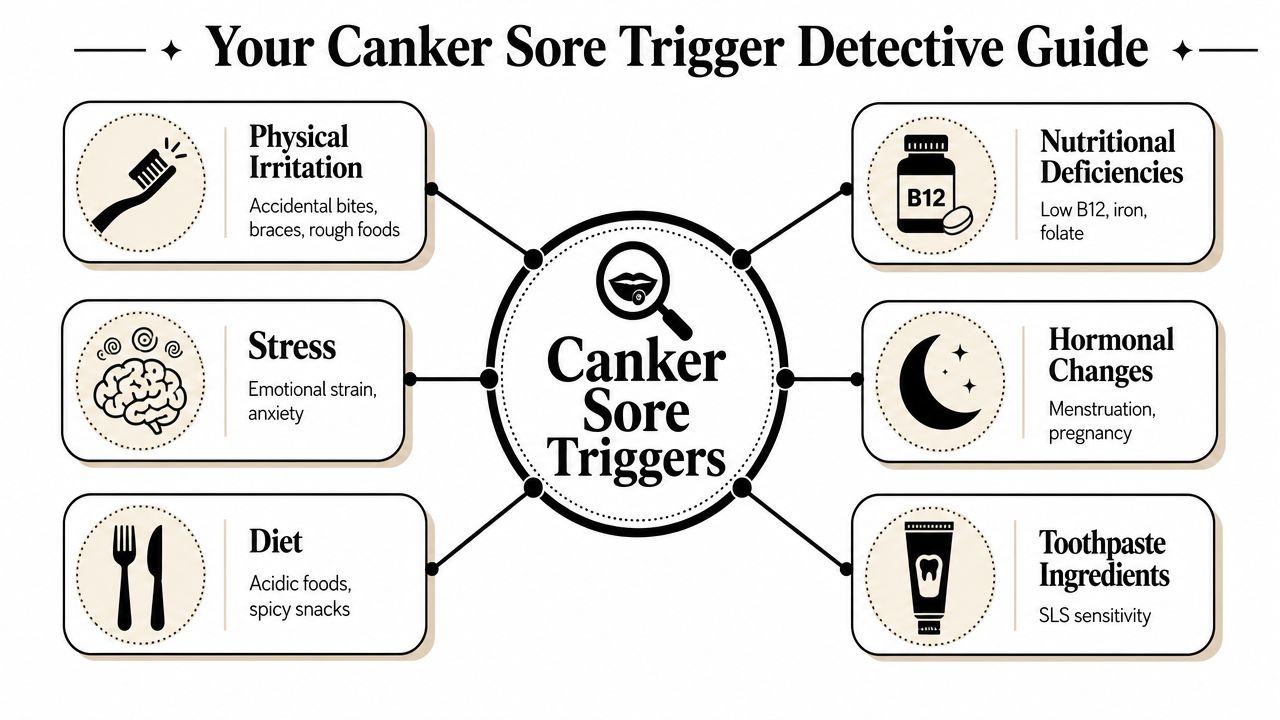
Think of canker sore triggers in groups rather than random events.
| Trigger group | What it can look like in real life |
|---|---|
| Physical irritation | cheek biting, rough brushing, sharp foods, orthodontic rubbing |
| Dietary irritants | citrus, tomatoes, salty foods, spicy meals |
| Toothpaste sensitivity | soreness that seems worse after using a certain toothpaste |
| Stress | outbreaks during busy or emotionally intense periods |
| Nutrient concerns | repeat sores that don't line up clearly with trauma or food |
| Hormonal shifts | some people notice timing-related flare patterns |
Physical irritation is one of the most overlooked causes. A tiny injury inside the mouth can be enough to start a sore. Patients often assume the sore “came out of nowhere” though it began with a rushed meal, a hard crust of bread, or a toothbrush that was used too aggressively.
Food can be just as important. Some mouths tolerate citrus and spicy food without any issue. Others react consistently. The key isn't avoiding everything forever. The key is learning what your tissues don't tolerate well.
Use a simple diary, not a complicated system
A diary-based elimination approach is one of the most useful tools for recurrent outbreaks. The Cleveland Clinic guidance on canker sores emphasizes identifying and removing individual triggers, and recommends a diary-based elimination approach for people who repeatedly ulcerate after food or toothpaste exposure.
You don't need a spreadsheet. A note on your phone is enough. Track:
What you ate
Especially acidic, salty, or spicy foods.What touched the area
New toothpaste, whitening products, braces, retainers, rough foods.Stress level that week
Look for timing patterns, not perfect certainty.Where the sore formed
The same location can be a useful clue.
After a few episodes, patterns usually start to stand out.
If a sore appears in the same place again and again, assume there may be a local irritant until proven otherwise.
What not to do
Many people make one of two mistakes. They either blame everything, which makes prevention feel impossible, or they blame one product too quickly and miss the true pattern.
A better approach is controlled trial and error. Change one likely trigger at a time and give it a fair test. If you switch toothpaste, don't also overhaul your whole diet that same week. If you're testing food triggers, keep the rest of your routine steady.
When sores are frequent, unusually painful, or hard to connect to obvious irritants, it's reasonable to have a dentist or physician look deeper. Nutrient deficiencies can play a role, and that's where professional guidance becomes more valuable than guessing.
Building a Gentle Daily Oral Care Routine
If your mouth is prone to canker sores, your oral care routine should clean thoroughly without creating friction. A lot of well-meaning people scrub harder when their mouth feels irritated. That usually backfires.
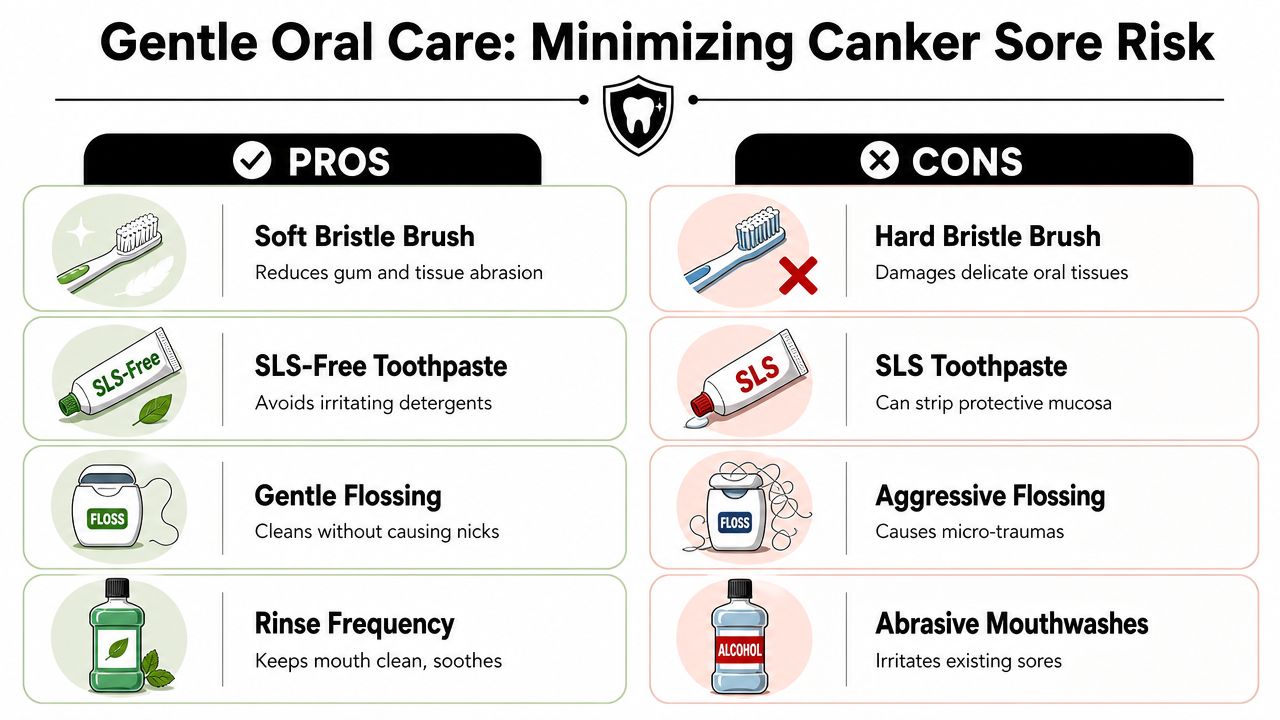
Start with the brush. A soft-bristled toothbrush is the safest default for people who want to prevent canker sores. According to Cedars-Sinai guidance on canker sore prevention, using a soft toothbrush and careful brushing helps reduce mucosal microtrauma, which is a common precipitating factor. The same guidance recommends trying a toothpaste without sodium lauryl sulfate, or SLS, if toothpaste seems to be a trigger.
Here's a quick visual summary of what helps and what tends to irritate.
How to brush without irritating the lining of your mouth
Gentle brushing doesn't mean ineffective brushing. It means controlled brushing.
Try this routine:
Choose a soft-bristled brush
If the bristles feel stiff against your cheek, they're probably too abrasive for a mouth that already gets sore easily.Use small circular motions
Don't saw back and forth across the gums and inner cheeks.Slow down near tender areas
The goal is to clean the teeth without scraping the surrounding tissue.Replace brushing force with brushing time
A longer, gentler clean works better than a fast scrub.
The same idea applies if you use a powered toothbrush. Let the brush do the work. Don't press it into the tissue.
Flossing should glide, not snap
People rarely connect flossing technique to canker sores, but they should. If floss snaps down hard into the gums or catches the inside tissue, it can create tiny injuries.
A better method:
- Use waxed floss if regular floss feels rough
- Guide it down gently instead of popping it between teeth
- Curve it around the tooth surface
- Move slowly in tight spaces
Protective wax can also help if braces or other appliances rub the inside of the mouth. Reducing small daily injuries is one of the most effective practical ways to prevent recurring sores.
For patients who want to tighten up the basics, our preventive dental care overview covers the kind of daily habits that support a healthier mouth overall.
A quick video can help if you're trying to improve brushing technique at home.
Toothpaste and mouth rinse trade-offs
Some people tolerate almost any toothpaste. Others don't. If canker sores seem to appear after switching brands, or if your mouth often feels dry or irritated after brushing, an SLS-free toothpaste is worth trying.
That doesn't mean every toothpaste with SLS causes sores. It means that for sensitive patients, it can be a practical variable to test.
Mouth rinses need the same common-sense approach. A rinse may help keep the mouth feeling cleaner, but rinses alone usually don't solve recurrence. If the trigger is cheek trauma, stress, or a certain food, the rinse won't remove the cause.
Chairside advice: If a product stings healthy tissue, not just the sore itself, it may be too harsh for your mouth.
A gentle routine is often less dramatic than over-the-counter ulcer products. It's also more useful long term because it lowers the chance that your daily habits are part of the problem.
Diet and Lifestyle Changes to Reduce Outbreaks
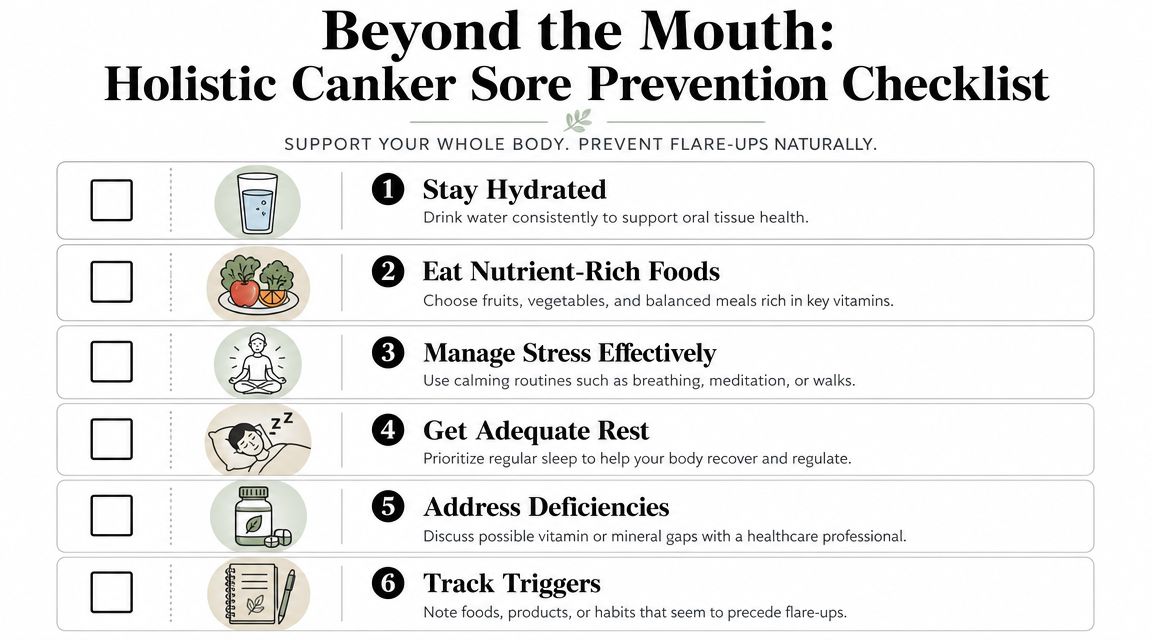
If your oral care routine is gentle but the sores keep returning, look beyond the sink. Many repeat outbreaks are tied to what you eat, how you recover from stress, and whether your body has what it needs to heal normally.
Prevention is less about finding a perfect product and more about reducing repeated irritation. That's why lifestyle changes often work better than people expect. They address the pattern, not just the pain.
Foods worth testing as triggers
If certain foods seem to burn, sting, or leave your mouth feeling raw, pay attention. The problem may not be the food itself. It may be that your oral tissues are sensitive to repeated exposure.
Common categories to test include:
Acidic foods
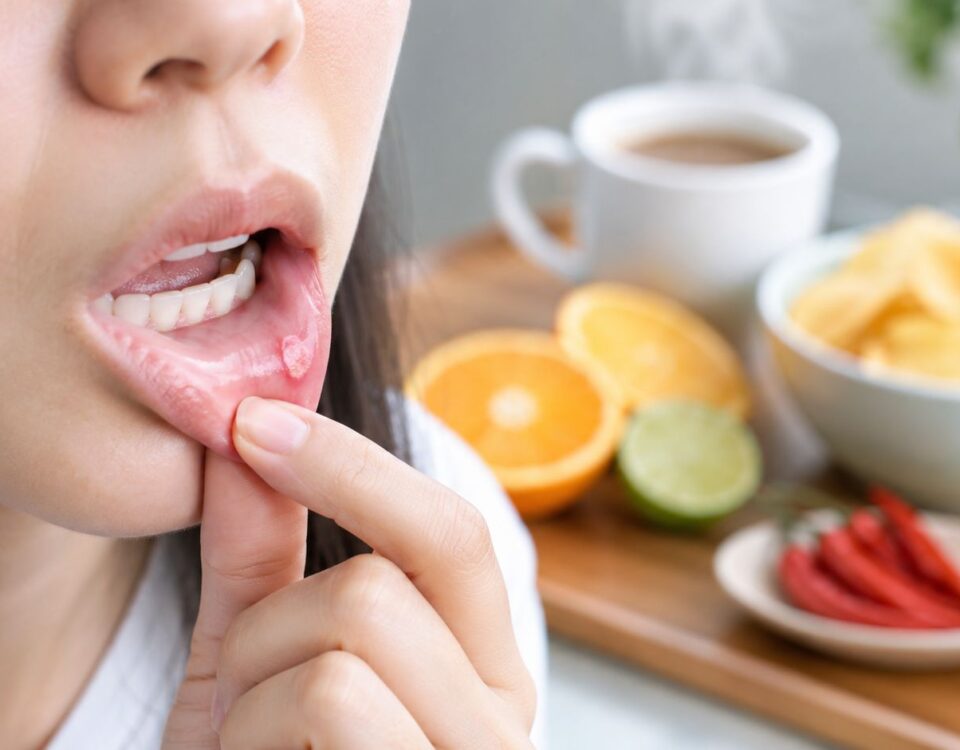
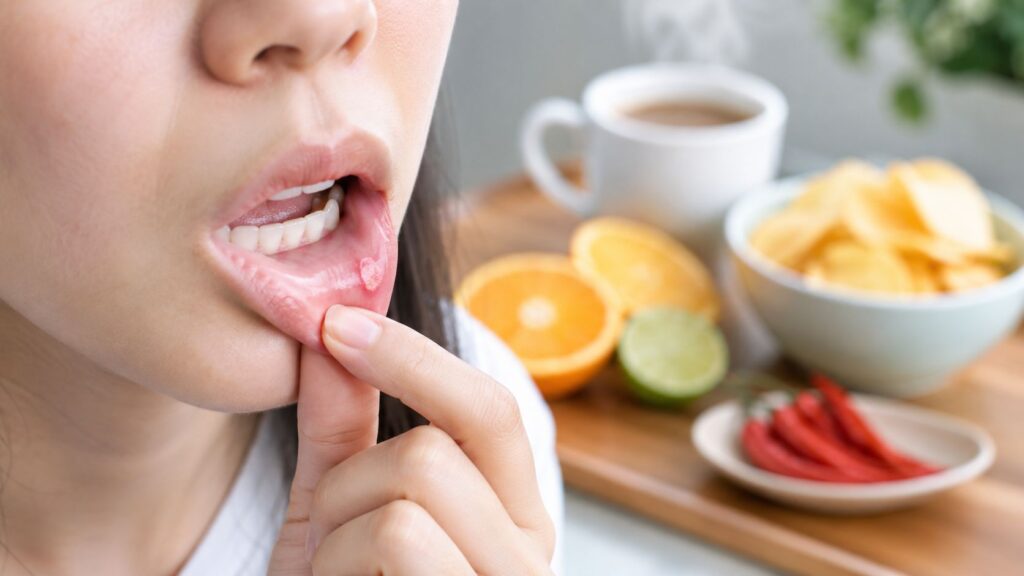
Citrus and tomatoes are frequent suspects when patients notice a consistent sting before an outbreak.Salty and spicy foods
These can irritate tissue that is already vulnerable.Rough or abrasive foods
Chips, crusty bread, and sharp-edged snacks can combine friction with irritation.
The smartest approach is selective, not extreme. Remove one likely trigger for a period of time, watch what happens, then reintroduce carefully if appropriate. If you cut everything at once, you won't know what mattered.
Nutrition still matters
When sores recur without an obvious mechanical or food trigger, nutrient issues should stay on the radar. Clinical references commonly point clinicians toward folate, vitamin B12, iron, and zinc when evaluating repeat canker sores. That doesn't mean you should self-diagnose a deficiency. It means diet quality and medical review can both matter.
A practical food pattern is simple:
| Goal | Helpful direction |
|---|---|
| Reduce irritation | choose softer, less acidic meals during vulnerable periods |
| Support healing | eat balanced meals consistently instead of skipping and snacking |
| Cover nutritional bases | include foods that support intake of B vitamins, iron, and zinc |
Hydration can help as well. A dry mouth is more easily irritated, and tissue that's already irritated tends to complain faster.
Stress is not a vague excuse
Patients sometimes dismiss stress because it sounds too general. But from a prevention standpoint, stress matters if your sores reliably show up during demanding stretches.
That's why I encourage people to think in patterns, not abstract wellness language. Did the outbreak appear during poor sleep, travel, illness, or a difficult week at work? Did you start clenching, bite your cheek more often, or eat more irritant foods at the same time? Stress can affect the mouth directly and indirectly.
Useful support habits include:
- Better sleep consistency
- Regular movement
- A calmer meal pace
- Noticing jaw tension or cheek chewing
- Keeping a brief trigger journal
The point isn't to live perfectly. It's to identify what repeatedly happens before a sore.
The most effective prevention plan is often boring on paper. Fewer irritants, steadier routines, and better pattern tracking.
Lifestyle changes can feel less satisfying than a medicated gel because they don't promise immediate relief. But when they match your personal triggers, they often do more to prevent canker sores from coming back in the first place.
When to Seek Professional Dental Care for Canker Sores
Home care has a place. Many minor canker sores improve with time, softer foods, gentle cleaning, and simple soothing measures. Supportive care can make the healing window more comfortable, especially if eating is painful.
But there's an important limit here. No therapy fully prevents recurrence. The American Academy of Oral Medicine information on canker sore treatment notes that treatment goals are to decrease pain, speed healing, and prevent recurrence, but also states that no available therapy meets all three goals.
That's why repeated self-treatment can become frustrating. You may be easing symptoms while the same trigger keeps causing the next sore.
What home care can and can't do
A reasonable at-home approach can include comfort-focused steps such as avoiding irritating foods, using a gentle oral care routine, and choosing bland, softer meals while the area settles down. These steps help reduce additional irritation.
What they don't do is diagnose why the sores keep returning.
That distinction matters. If a sore is one-time and mild, support is often enough. If sores are recurring, severe, or don't fit the usual pattern, a professional exam is more useful than trying stronger products at random.
Red flags worth acting on
Call a dentist if you notice any of these patterns:
The sore lasts longer than expected
A lesion that hangs on needs a closer look.The pain is strong enough to interfere with eating or drinking
Pain control and tissue protection may need a different plan.The sores are frequent
Recurrent outbreaks justify a real trigger review.The ulcer seems unusually large or atypical
Not every mouth sore is a simple canker sore.
A recurring mouth ulcer deserves the same common-sense attention you'd give any other problem that keeps returning in the same way.
A dental visit is not only about treatment. It's about ruling out other causes, checking for local trauma, and deciding whether the pattern points toward appliance irritation, oral habits, or a broader health issue that should be evaluated further.
Partner with Your Cornelius Dentist for Lasting Relief
When canker sores become a pattern, the next useful step is a personalized exam. That visit is less about handing you one more rinse and more about building a plan around what your mouth does.
A dentist starts by looking for local causes. That may include friction from a tooth edge, an appliance, or a restoration that irritates the same area over and over. It also includes reviewing your history. Where the sores appear, what you were eating, whether stress was high, and which products you use at home.

What a personalized prevention plan may include
Each plan looks a little different, but it often includes a combination of the following:
A careful oral exam
This helps rule out other sources of sores and spot mechanical irritation.Review of your daily routine
Brushing habits, flossing technique, toothpaste choice, and diet all matter.Appliance and bite evaluation
If you wear aligners, have orthodontic attachments, or need restorative work such as crowns or bridges, reducing trauma becomes part of the strategy.Guidance on medical follow-up when appropriate
If the pattern suggests a possible deficiency or a broader health issue, your dentist can help guide next steps.
This kind of visit is especially useful for families. Kids, teens, and adults don't always have the same triggers, and one generic handout rarely solves the problem for everyone.
Why local follow-up helps
Good prevention usually takes adjustment. You try one change, watch the result, then refine the plan. That's easier when you have a dentist nearby who knows your history and can reassess if the pattern changes.
If you're ready to talk through recurring sores, food triggers, appliance irritation, or a gentle oral care routine, you can contact our Cornelius dental office to schedule a visit.
For many patients, lasting relief starts when the problem stops being treated like a random inconvenience and starts being managed like a real pattern.
If recurring mouth sores are making meals, brushing, or daily life uncomfortable, schedule a consultation with Skotzko Family Dental Clinic. We help patients in Cornelius and nearby communities identify likely triggers, protect sensitive tissues, and build a practical plan to prevent future flare-ups.