
How to Prepare for a Root Canal: A Patient’s Guide
June 17, 2026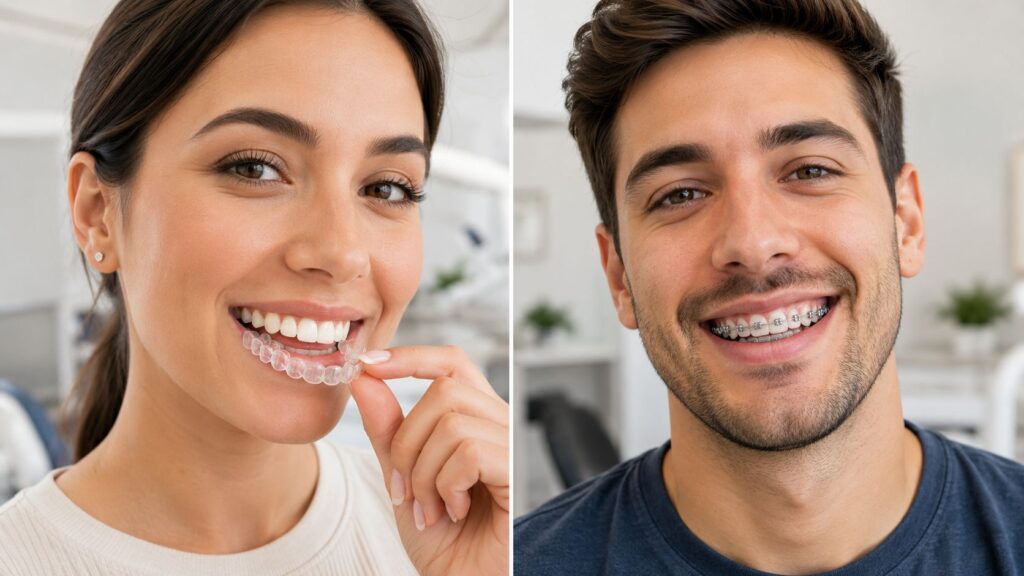
If you're an adult thinking about straightening your teeth, you're probably not starting from a blank slate. You may have lived with crowding for years. Maybe your front teeth overlap in photos, or you notice your bite feels off when you chew. A lot of adults in Cornelius put this decision off because life is busy, work is public-facing, and the idea of orthodontic treatment can feel like something you were supposed to do as a teenager.
That hesitation is normal. It also doesn't mean you've missed your chance.
For many adults, the question isn't whether straighter teeth would help. It's which option fits real life better. Invisalign and braces can both move teeth. The difference usually comes down to your goals, your dental needs, and how treatment will fit into your work, meals, routines, and long-term habits.
Considering a Straighter Smile as an Adult in Cornelius
A common story goes like this. Someone sees themselves in a family picture from Jetton Park or a work event near the lake, and instead of noticing the moment, they focus on one tooth that always seems to turn inward. They smile with their lips closed after that. Not because the problem is severe, but because it's been bothering them internally for a long time.
Adults usually don't come in saying, "I want orthodontics because it's exciting." They come in because something practical changed.
Sometimes it's confidence. Sometimes it's a wedding, a job change, or the feeling that dental work should finally move off the mental to-do list. Sometimes it's less about looks and more about cleaning around crowded teeth, noticing uneven wear, or feeling like their bite just isn't lining up well anymore.

Why adults often wait so long
Most adults aren't confused about whether crooked teeth can be treated. They're unsure about what treatment would mean day to day.
Questions tend to sound like this:
- Will braces make me feel self-conscious at work
- Will Invisalign work for my teeth
- How disruptive will this be to eating, speaking, and cleaning
- Am I too old for this to be worth it
The short answer is that adult orthodontic treatment can be very worthwhile. The more helpful answer is that Invisalign and braces solve the same problem in different ways, and each comes with tradeoffs.
Many adults don't need more hype. They need a clear explanation of what mornings, meals, meetings, and maintenance will actually feel like.
A local decision, not just a dental one
If you're comparing Invisalign vs braces for adults, you're not just choosing an appliance. You're choosing a routine you'll live with for months. That's why the right answer isn't always the one that looks best in a brochure.
In Cornelius, where people often balance work, commuting, family schedules, and community life, convenience matters. So does predictability. A treatment plan should make clinical sense, but it also has to fit how you live. When adults understand that clearly, the decision usually feels much less overwhelming.
The Two Paths to a Straighter Smile An Overview
Traditional braces and Invisalign both move teeth by applying controlled pressure over time. The goal is the same. Teeth gradually shift into better positions so your smile and bite improve. The difference is in how that pressure is delivered.
Here's a quick side-by-side view before we get into details:
| Feature | Invisalign | Braces |
|---|---|---|
| How it works | Series of clear removable aligners | Brackets and wires fixed to the teeth |
| Appearance | More discreet | More visible |
| Wear style | Must be worn consistently, but removed for meals and brushing | Stays on full time |
| Best fit | Often used for mild to moderate alignment needs | Often preferred for more complex tooth movement and bite correction |
| Daily discipline | High | Lower |
| Cleaning | Easier to brush and floss normally | More technique required around brackets and wires |
How braces move teeth
Braces use small brackets attached to the teeth and a wire that connects them. As the wire is adjusted, it guides teeth into new positions. Because braces stay in place, they work continuously. You don't have to remember to put them back in after lunch or after coffee.
That fixed design is one reason braces remain such a reliable option for adults with more challenging tooth movement. When a dentist needs stronger control over rotation, spacing, or bite correction, braces often give more direct mechanics.
How Invisalign moves teeth
Invisalign uses a series of custom clear aligners. Each set is shaped a little differently from the one before it, so your teeth move in stages. Instead of wires pulling teeth, the aligners fit snugly and guide movement according to a digital treatment plan.
That removable design is the biggest appeal for many adults. You can take the aligners out to eat, brush, and floss. For someone who wants a more discreet look in meetings, social events, or daily life, that can be a major advantage.
Invisalign is also well established. Published summaries note that more than 18 million patients have been treated worldwide, and clear aligner success rates are commonly cited around 88% to 90% for many cases, which is one reason it's viewed as a mature mainstream option rather than an experimental one (published Invisalign adoption and success summary).
What often confuses adults
People sometimes assume the choice is simple. Braces are for serious cases. Invisalign is for cosmetic touch-ups. Real life is more nuanced than that.
Some adults are excellent Invisalign candidates because their tooth movement fits aligner mechanics and they're highly consistent. Others may prefer Invisalign for appearance but do better with braces because fixed treatment doesn't rely on daily wear discipline in the same way.
Helpful way to think about it: braces are always on. Invisalign only works when you're wearing it.
That single difference shapes almost every practical decision that follows.
Invisalign vs Braces A Detailed Head to Head Comparison
Adults usually compare these options by asking one big question. Which one will be less disruptive to my life? That's the right question. Clinical fit matters first, but day-to-day reality matters a lot too.
Appearance in work and social settings
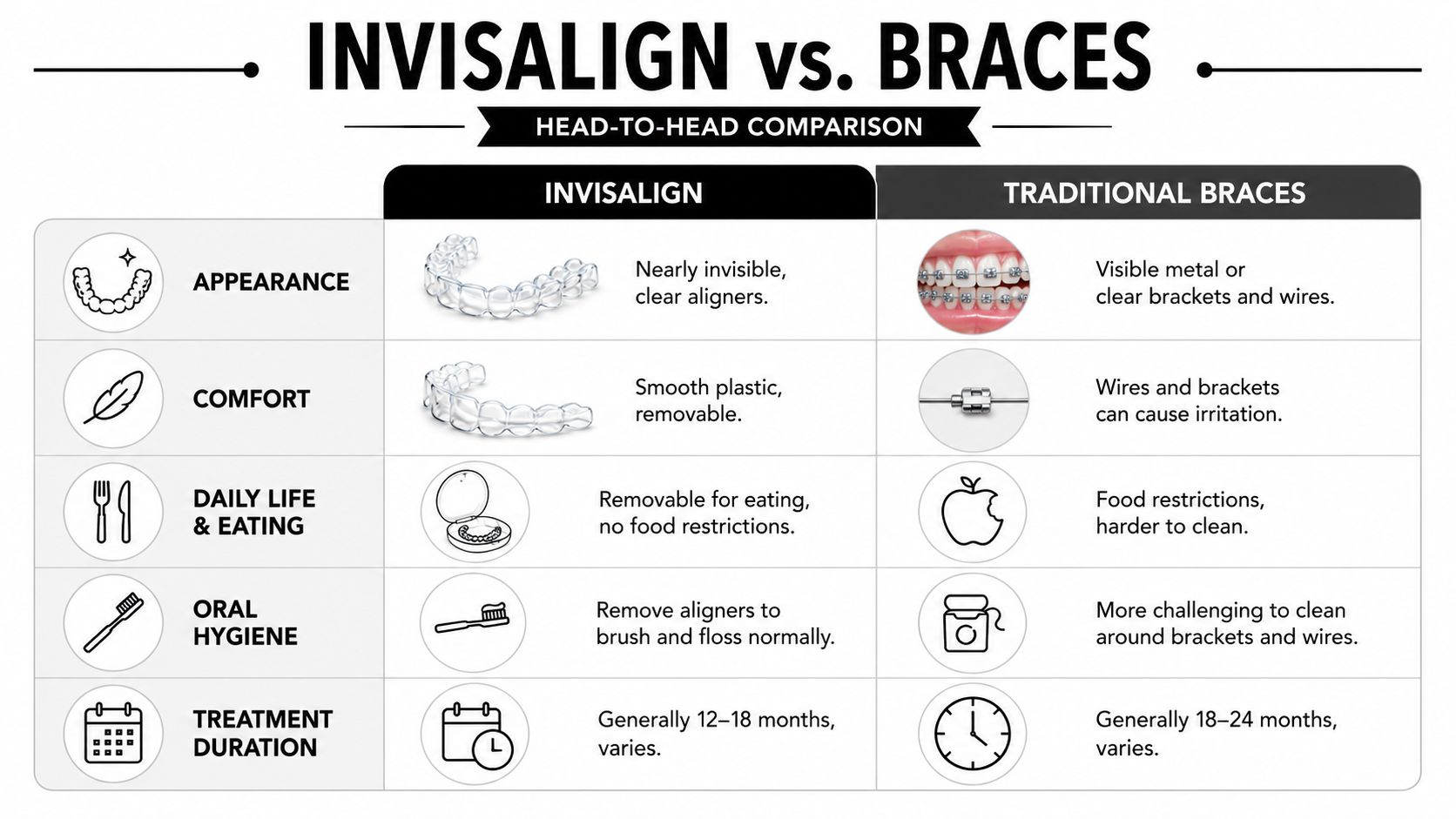
For adults, appearance is often the first concern. If you talk with clients, lead meetings, attend church, go to community events, or do not want orthodontic treatment to be the first thing people notice, Invisalign has a clear advantage in discretion. The aligners are transparent and sit closely over the teeth.
Braces are more visible. Even when adults feel less bothered by that than they expected, they're still noticeable. Some people don't mind this at all. Others know from the start that visibility will affect their confidence.
That doesn't make Invisalign automatically better. It just means its biggest lifestyle advantage shows up the moment you smile.
If your top priority is keeping treatment subtle, Invisalign usually feels more comfortable socially.
Comfort and the first few weeks
Neither option is completely sensation-free. Teeth move because pressure is being applied, so some soreness is normal when treatment begins or changes are made. The difference is usually in the kind of irritation patients notice.
With Invisalign, the trays are smooth plastic. Adults often like that there are no brackets or wires rubbing against the lips and cheeks. You may notice pressure when switching to a new aligner, and speech can sound slightly different at first, especially with certain sounds, but many people adapt quickly.
With braces, the mouth sometimes needs time to get used to hardware. Brackets and wires can create sore spots until the cheeks and lips adjust. Orthodontic wax can help, but this is a real part of the early experience.
Eating and everyday routines
At this point, adult patients often become very decisive.
With Invisalign, you remove the aligners before meals and snacks. That means no food restrictions in the usual sense. If you want salad, steak, popcorn, or apples, you can eat them. But there's a catch. After eating, you need to brush when possible and put the aligners back in. Snacking becomes less casual because every removal interrupts wear time.
Braces flip that equation. You don't remove anything, but you do need to be more careful about what you eat. Certain foods are harder on brackets and wires, and cleaning afterward takes more effort.
A simple way to compare it:
- Invisalign gives you food freedom but asks for more discipline.
- Braces limit some foods but remove the need to decide whether your treatment is in or out.
For adults who graze throughout the day, sip coffee for hours, or frequently forget routines, Invisalign can become more inconvenient than expected.
A helpful overview of clear aligner treatment options is available on the practice's Invisalign page.
Later in the decision process, many adults find it useful to watch a straightforward visual explanation alongside written comparisons.
Treatment time and speed
A lot of online discussions oversimplify timing. In some adult cases, Invisalign can be efficient. In others, braces finish sooner.
A retrospective study found average treatment times of 1.7 years for Invisalign and 1.3 years for braces, with braces finishing about 0.4 years earlier on average. The same study reported that, in simple malocclusions, aligners took 4.8 months longer than traditional braces, while overall occlusal outcomes at six months after treatment were similar (retrospective comparison in The Angle Orthodontist).
That matters because adults often hear only one version of the story. They hear Invisalign is faster because it's modern, or they hear braces always take longer because they're traditional. Neither is a safe assumption across all cases.
Practical rule: if speed is your top priority, don't guess. Ask which option is likely to move your teeth more efficiently.
Compliance and why it changes everything
This is the part many adults underestimate. Invisalign aligners need to be worn for about 20 to 22 hours per day to work as intended because they only apply force while they're in your mouth (Invisalign wear-time guidance).
Braces don't have that problem. They're fixed. They keep working while you're answering emails, driving, sleeping, or eating.
That's why braces often have an advantage for adults who know they struggle with consistency. If you're very organized and don't mind a structured routine, Invisalign can fit beautifully. If you're realistic about forgetting things, long lunches, frequent coffee, or taking trays out and leaving them wrapped in a napkin, fixed braces may be the more dependable choice.
Cleaning and maintenance
Oral hygiene looks different with each option.
With Invisalign, you remove the trays and brush and floss normally. That's a major convenience. You also have to keep the aligners clean, because clear plastic can collect buildup and odors if it's neglected.
With braces, brushing takes more time and more intention. Food collects around brackets and wires, and flossing is less straightforward. Some adults handle this easily once they learn the technique. Others find it frustrating.
Here's the tradeoff in plain language:
| Daily task | Invisalign | Braces |
|---|---|---|
| Brushing | Simple once aligners are out | More detailed around brackets |
| Flossing | Similar to normal flossing | Takes more technique |
| Appliance care | Clean trays regularly | Watch for trapped food and broken hardware |
| Routine burden | More wear-time discipline | More cleaning discipline |
For many adults, Invisalign feels easier in the bathroom and braces feel easier in the rest of life. That's a surprisingly useful way to think about it.
Which Is Right for You Candidacy for Braces vs Invisalign
Preference matters, but candidacy comes first. You may prefer the look of Invisalign and still be a better fit for braces. Or you may assume braces are necessary when your case is well suited to aligners.
The biggest factor is the type of tooth movement needed.
When Invisalign is often a strong fit
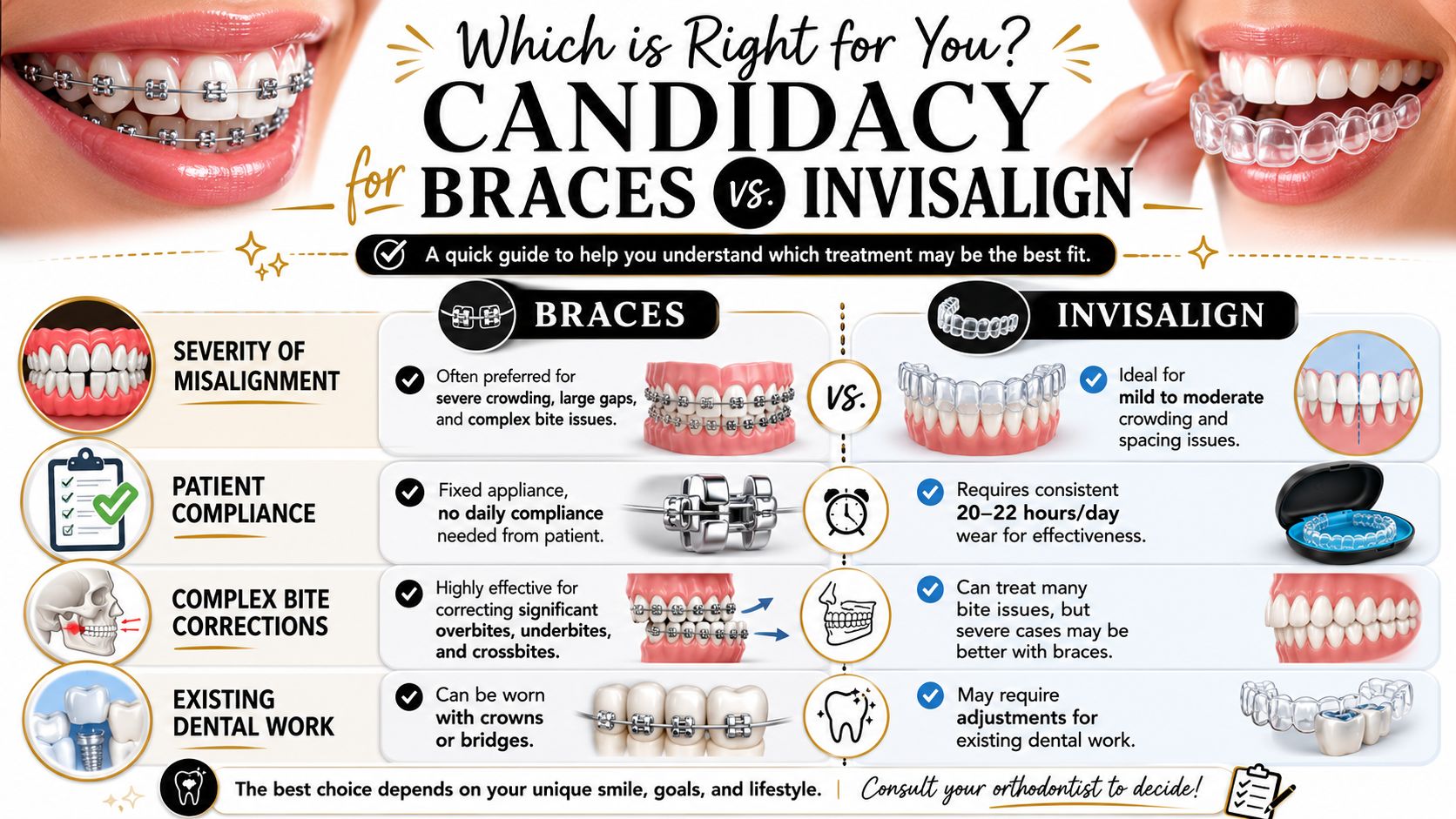
Adult Invisalign treatment is typically positioned for mild to moderate alignment issues, with treatment windows commonly around 12 to 18 months, while braces are more often recommended for complex malocclusions, severe crowding, and significant bite correction, with treatment commonly around 18 to 24 months (adult case selection overview).
In practical terms, Invisalign often makes sense when the main concerns are things like:
- Mild crowding where teeth need room to line up
- Small spacing issues between teeth
- Cosmetic alignment concerns that affect the smile more than the bite
- Adults with strong routines who can keep aligners in most of the day
For these patients, clear aligners can be a very appealing combination of appearance and function.
When braces may be the better tool
Braces tend to be favored when the movement is more demanding. That can include significant crowding, more complicated bite correction, and cases where teeth need broader mechanical control.
A useful way to think about it is this. Some tooth movements are like making fine adjustments to a picture frame. Others are more like remodeling a doorway so everything lines up correctly. Invisalign can be excellent for the first category. Braces often give more control for the second.
Adults who may lean toward braces include those with:
- More severe crowding
- Bite problems such as overbite, underbite, or crossbite that need more involved correction
- Teeth that need major rotation or repositioning
- A history of inconsistent routines, where removable treatment may become frustrating
Some adults are perfect Invisalign candidates on paper but poor candidates in daily life. Compliance isn't a side detail. It's part of the diagnosis.
What about existing dental work
Another point adults often miss is how crowns, bridges, fillings, or other dental history can affect planning. That doesn't automatically rule out either option, but it does mean your treatment plan should be customized carefully. The presence of older restorations, worn teeth, or gum concerns can influence which path is more practical.
This is one reason online quizzes aren't enough. They can be helpful for general education, but they can't look at your bite, your restorations, your bone support, and how your teeth come together.
Questions that can help you self-identify
Before a consultation, it can help to ask yourself:
- Is my main concern cosmetic, functional, or both
- Do I tend to follow daily routines closely
- Would I rather manage removable trays or fixed hardware
- Am I willing to trade discretion for stronger mechanical control if needed
Those answers won't replace an exam, but they often reveal what matters most to you. For adults comparing Invisalign vs braces for adults, the best decision usually comes from matching the dental problem with the treatment method and matching the treatment method with the person's real habits.
Your Orthodontic Journey in Cornelius with Dr Skotzko
For most adults, the first appointment isn't about committing on the spot. It's about getting clarity. You want to know what you're dealing with, what your options are, and whether the treatment plan fits your goals and schedule.
A typical visit starts with records and evaluation. That may include photos, X-rays, and digital scans so the teeth and bite can be reviewed carefully. From there, the conversation becomes much more specific. Instead of asking, "Do braces or Invisalign work?" you're asking, "Which one makes sense for my smile?"
If Invisalign is the right fit
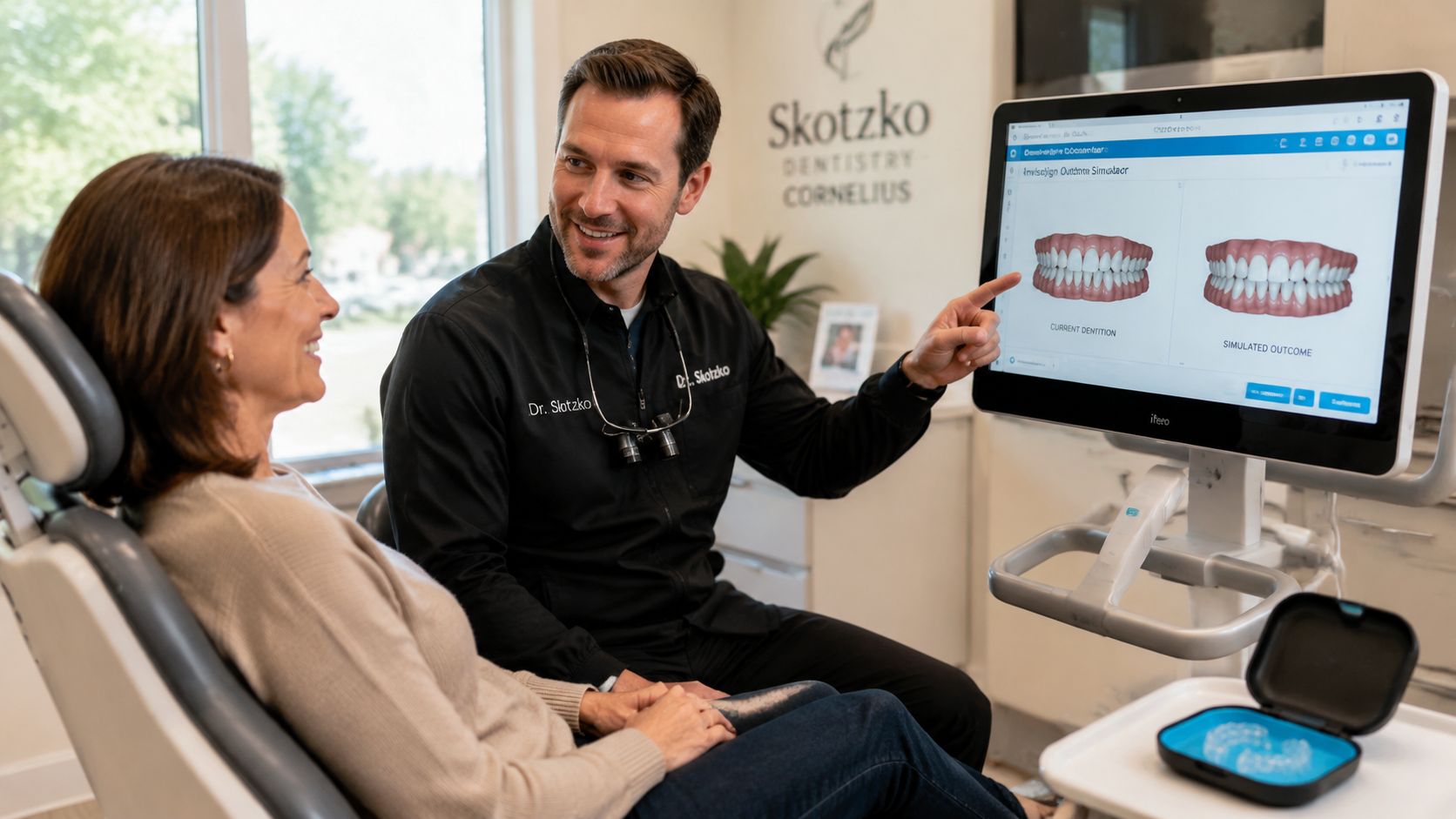
Adults often appreciate seeing the plan digitally. With Invisalign, the treatment is typically mapped out before the aligners are made, so you can review how teeth are expected to move over time. That tends to make the process feel less abstract.
You'll also talk through the routine. How often you'll switch aligners. How to clean them. What to expect when a new set feels tight. The success of Invisalign depends not just on the plan, but on how consistently the trays are worn in everyday life.
If braces are the better choice
If braces make more clinical sense, the process is different but still straightforward. Brackets are placed on the teeth, wires are attached, and follow-up visits are used to adjust the system as treatment progresses.
Adults are often relieved to learn that the biggest adjustment is usually routine, not mystery. You learn what foods to be careful with, how to clean around brackets, and what mild soreness to expect after adjustments. Once that routine settles in, many people find braces more manageable than they feared.
The most reassuring part of orthodontic treatment is usually not the appliance. It's knowing what comes next.
Support throughout the process
Whether treatment uses aligners or braces, regular follow-up matters. Teeth don't move well on autopilot. Progress has to be checked, small changes may need to be made, and questions come up along the way. That's especially true for adults balancing treatment with work and family life.
Information about Dr. Daniel Skotzko's background and local practice can be found on the Dr. Skotzko profile page.
For adults in Cornelius, predictability matters. Knowing what the first visit includes, what the next step will be, and how the process unfolds tends to lower anxiety more than anything else.
Understanding the Investment Cost and Insurance for Adult Orthodontics
Cost is one of the first questions adults ask, and that makes sense. Orthodontic treatment is a planned investment, not an impulse purchase. Adults want to understand not just the final fee, but what drives it.
What affects the cost
The main cost factors are usually the complexity of your case, the length of treatment, and the kind of appliance being used. A short, straightforward alignment case is different from a more involved bite correction that needs longer monitoring and more detailed mechanics.
That's why two adults can both ask for Invisalign and receive very different treatment recommendations. The fee reflects the work required to move teeth safely and predictably, not just the label of the treatment.
Why comparing quotes can be tricky
Adults sometimes try to compare orthodontic pricing the way they would compare household services. The problem is that one treatment plan may include more complex movement, more refinements, or a longer course of care than another. A lower fee doesn't always mean the same scope of treatment.
What matters more is understanding:
- What problem is being treated
- How long treatment is expected to take
- What follow-up care is included
- What happens if adjustments are needed during treatment
- What retention will involve after active treatment ends
How insurance usually fits in
Adult orthodontic coverage varies a lot by plan. Some plans include orthodontic benefits for adults. Others only cover treatment for children or adolescents. Many adults don't know what their policy includes until the office helps review the details.
It's smart to ask about:
- Lifetime orthodontic benefits
- Whether adult treatment is included
- How payments are applied over time
- Whether Invisalign and braces are covered differently under the plan
Payment planning matters
Because orthodontics is scheduled care, many adults prefer a payment structure that feels manageable rather than paying everything at once. That may include staged payments or third-party financing, depending on what's offered.
This is one place where a clear consultation helps. You're not only deciding between braces and aligners. You're deciding how treatment fits your household budget and timeline. A good financial discussion should feel as understandable as the clinical one.
Frequently Asked Questions About Adult Orthodontics
Does Invisalign or braces hold up better long term
Both can work well when treatment is properly planned and followed by retention. A comparative clinical study found high malocclusion-correction success rates with both treatments, at about 88% for Invisalign and 90% for conventional braces, while the Invisalign group showed slightly more relapse at 12% versus 10%, suggesting braces may offer somewhat better stability in some cases (comparative study on success and relapse).
The practical lesson isn't that one option always "wins." It's that retainers matter a lot. Teeth have a memory. After active treatment ends, retention helps keep them where they were moved.
If you're not likely to wear retainers consistently after treatment, that's a bigger long-term risk than the logo on the appliance you used.
Is orthodontic treatment more painful for adults
Adults often worry they'll handle treatment worse than teenagers. In reality, most adults describe the experience as manageable, especially once they know what sensations are normal. Pressure, tightness, and temporary soreness are common when teeth begin moving or when appliances are adjusted.
Adults also tend to be more aware of small changes, which can make the first days feel more noticeable. But "noticeable" and "unmanageable" aren't the same thing. Knowing what to expect usually reduces anxiety.
What happens after treatment is finished
Active treatment is only part of the process. After braces come off or Invisalign ends, you'll move into the retention phase. That's the part designed to keep the result stable.
Retainers are not an optional add-on. They're part of finishing treatment well. Adults who understand that early tend to protect their investment better and are less surprised by the commitment involved.
Which option is better if I have a busy schedule
That depends on what kind of busy you mean. If your days are packed and you don't want to think about treatment constantly, braces may be easier because they stay in place. If your schedule includes lots of face-to-face meetings and you value a more discreet look, Invisalign may fit better, as long as you're consistent.
This is why no honest answer should sound one-size-fits-all. The best choice is the one that matches your dental needs and your actual habits.
Can adults still benefit even if their teeth have been crooked for years
Yes. Adults seek orthodontic treatment for long-standing crowding, spacing, bite concerns, and cosmetic goals all the time. The key is having your teeth, gums, and bite evaluated first so treatment is based on your current oral health, not just on appearance.
For many adults, the biggest surprise is not that treatment is possible. It's that the process feels more practical and more personalized than they expected.
If you're weighing Invisalign and braces and want a clear, pressure-free conversation about what fits your smile and your daily life, contact Skotzko Family Dental Clinic. Adults in Cornelius and nearby communities can schedule a consultation to review their bite, discuss treatment options, and get a plan that makes clinical and practical sense.