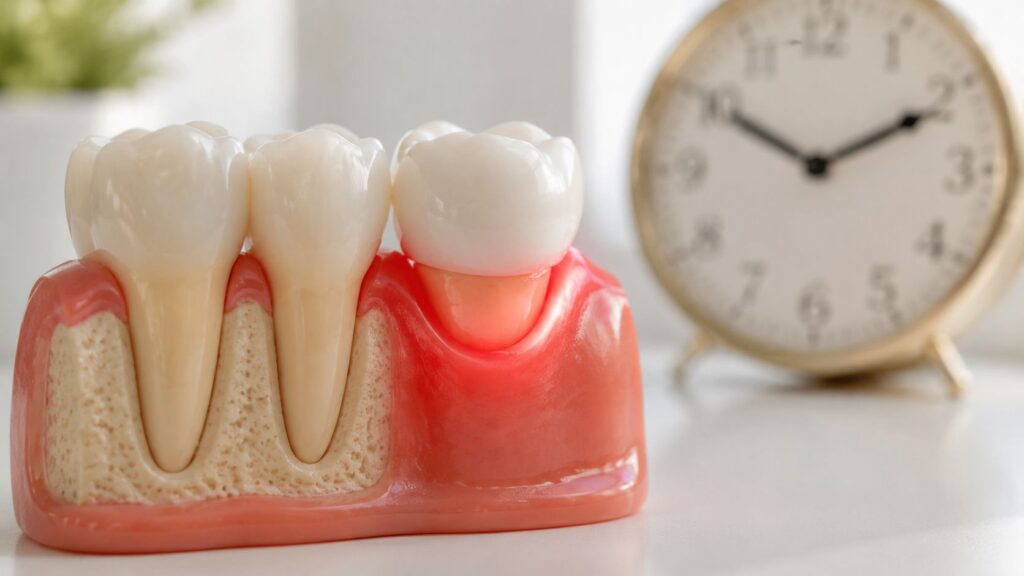

A Test for TMJ: Your Guide in Cornelius, NC
June 11, 2026
Veneers Before and After: 7 Smile Stories from Cornelius, NC
June 13, 2026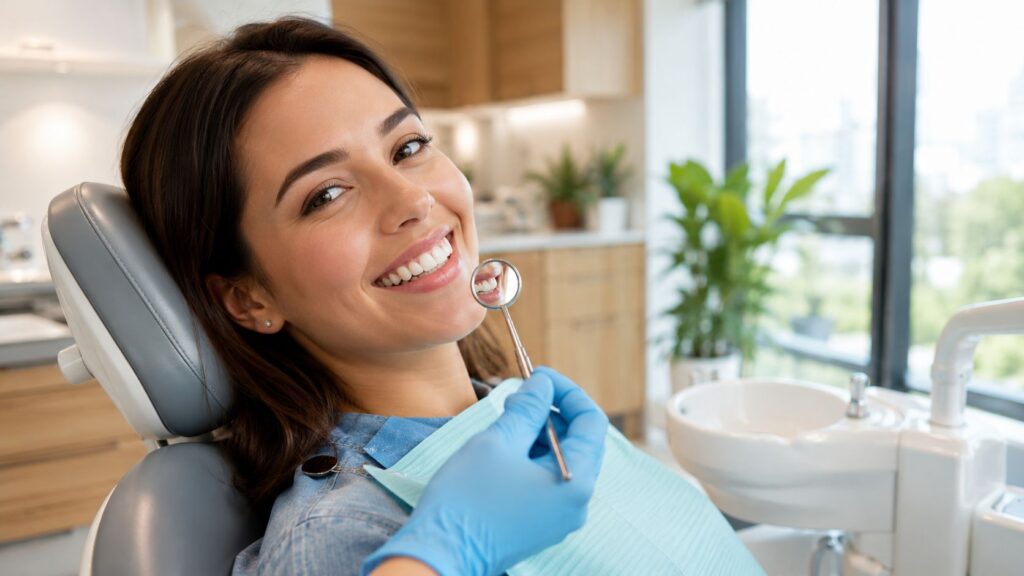
If you've been typing Cosmetic Dentistry Near Me into your phone after catching your smile in a photo, you're not alone. A lot of people in Cornelius want the same thing. They want to feel comfortable laughing, talking, and smiling without thinking about stains, chips, gaps, or a tooth that seems to draw all the attention.
Patients don't usually begin with a long list of procedures in mind. They start with a simple question: 'What would help my smile?' That's the right question to ask. Cosmetic dentistry isn't one treatment. It's a group of options, and the best one depends on what you want to change, what your teeth need clinically, and how long you want the result to last.
For many patients, the confusing part isn't finding a dentist nearby. It's figuring out whether whitening, bonding, veneers, Invisalign, or even implants make the most sense. That's where good guidance matters. If you understand what each option does well, the path forward feels much less intimidating.
Your Guide to a Confident Smile in Cornelius NC
A familiar moment goes something like this. You're getting ready in the morning, you glance in the mirror, and your eyes go straight to one thing you wish looked different. Maybe your teeth seem darker than they used to. Maybe one front tooth has a chipped edge. Maybe there's a small gap you've noticed for years and never loved.
That kind of concern can sound small when you say it out loud, but it rarely feels small to the person living with it. Your smile shows up in conversations, family pictures, work meetings, and first impressions. When you don't feel good about it, you often start adapting without even realizing it. You smile with your lips closed. You angle your face in photos. You laugh, then cover your mouth.

That reaction makes sense. In a widely cited consumer survey by the American Academy of Cosmetic Dentistry, 99.7% of adults believed a smile is an important social asset, and 74% said an unattractive smile can hurt a person's chances for career success, as summarized by Delta Dental's AACD overview.
Why this matters more than vanity
Cosmetic dentistry gets mislabeled as “just for looks,” but that misses the underlying reason. Looking better and feeling more comfortable often go together. When patients ask about improving their smile, they're usually asking for relief from self-consciousness just as much as they're asking for a brighter or straighter look.
A smile concern doesn't have to be severe to be worth addressing. If it affects your confidence, it matters.
What local patients usually want
In Cornelius, most cosmetic concerns fall into a few common categories:
- Color changes from coffee, tea, tobacco, or deeper internal staining
- Shape problems such as uneven edges, short teeth, or worn enamel
- Spacing issues like small gaps or mild crowding
- Damage including chips, cracks, or old visible fillings
- Missing teeth that affect both appearance and bite
The encouraging part is that these concerns often have more than one possible solution. A better smile usually isn't out of reach. It just starts with matching the right treatment to the right problem.
What Is Cosmetic Dentistry and What Can It Do for You
Cosmetic dentistry focuses on improving the appearance of your teeth and smile, but it often overlaps with oral health and function too. A treatment may brighten teeth, close a gap, replace a missing tooth, protect worn enamel, or improve the way teeth line up. That's why the word “cosmetic” can be a little misleading. Many smile treatments are about both appearance and practical function.
The three main goals
Most cosmetic treatment plans aim to improve one or more of these areas:
Color
If your teeth look yellow, gray, blotchy, or darker than you'd like, the first question is why. Some stains sit on the outside of the tooth. Others are deeper within the tooth structure. That difference matters because the right fix for surface staining may not be the right fix for internal discoloration.
Shape
Some smiles look less balanced because of chipped corners, worn edges, uneven lengths, or naturally small teeth. In those cases, changing the shape of a tooth may make a bigger difference than making it whiter.
Alignment
If teeth overlap, twist, or leave visible spaces, the issue is often positioning. Whitening won't move teeth. Bonding can help in selected cases, but if the core problem is crowding or spacing, orthodontic treatment may be the better long-term answer.
What the common options actually do
Here's the plain-language version of the main cosmetic choices patients ask about most:
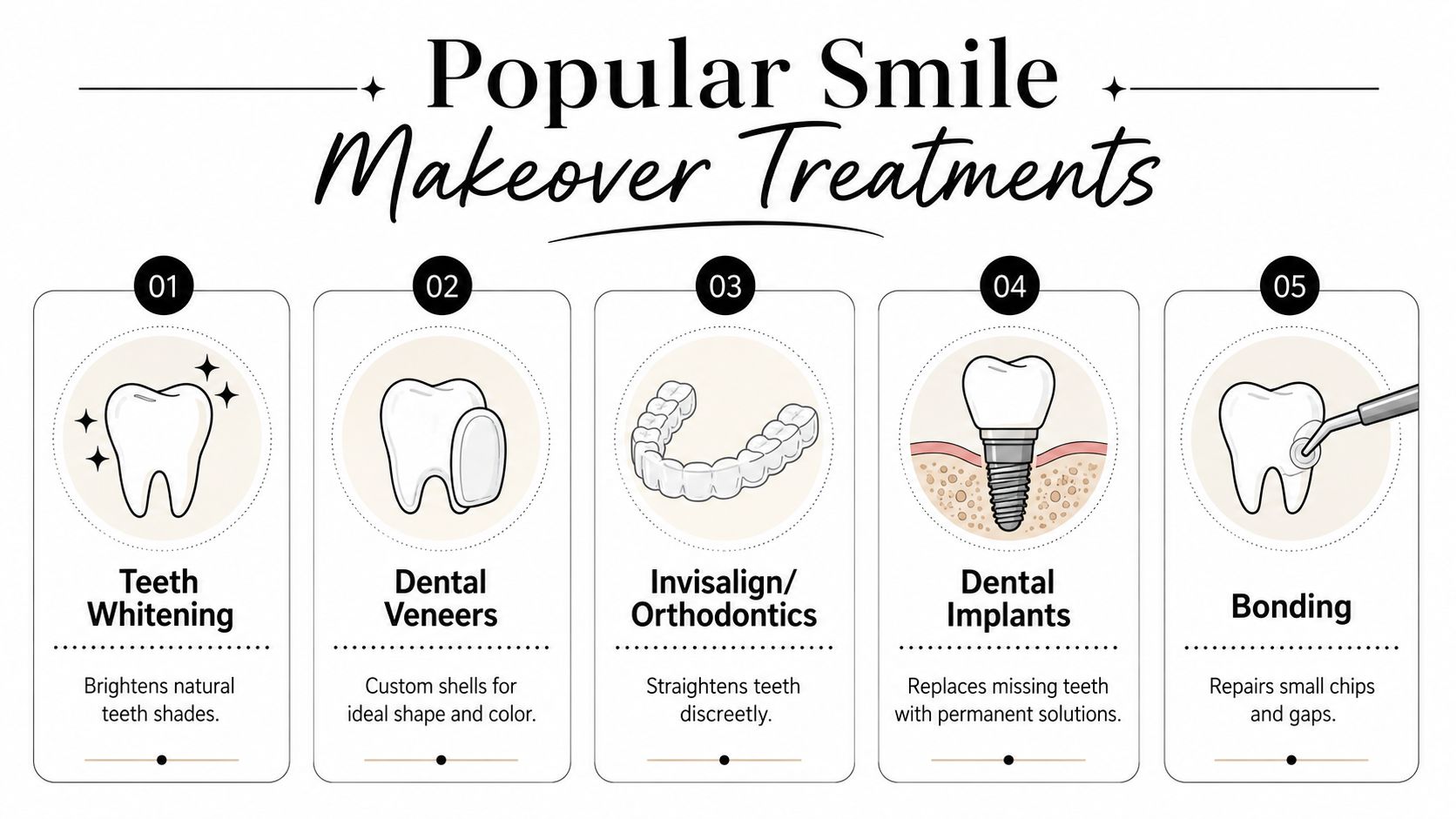
- Teeth whitening brightens natural teeth when discoloration is the main concern.
- Bonding uses tooth-colored material to repair small chips, reshape edges, or close minor spaces.
- Porcelain veneers cover the front surface of teeth to improve color, shape, size, and sometimes spacing.
- Invisalign moves teeth into better positions with clear aligners.
- Dental implants replace missing teeth with a fixed solution that restores appearance and chewing function.
- Cosmetic white fillings replace dark or noticeable restorations with a more natural look.
Cosmetic care is not one-size-fits-all
Many people often get stuck. They assume there's a “best” cosmetic treatment overall. There isn't. There's only the treatment that fits your goal, your tooth condition, and your priorities.
Practical rule: The right cosmetic treatment should solve the actual problem, not just cover it up.
For example, if your teeth are healthy but stained on the surface, whitening may be enough. If one front tooth has a chipped edge and uneven shape, bonding may be a simple answer. If you want a broad change in color and shape across several front teeth, veneers may be more appropriate. If your biggest complaint is crowding, Invisalign may address the cause rather than disguising the symptom.
Cosmetic dentistry can be part of a bigger plan
Some people also need restorative care before cosmetic work. A worn tooth may need more support. A missing tooth may call for an implant. Gum health may need attention first. That doesn't mean cosmetic improvement is off the table. It means the plan should be built on a healthy foundation.
Good cosmetic care is thoughtful. It doesn't begin with “What procedure can we sell?” It begins with “What are you hoping to change, and what's the safest, most predictable way to do that?”
A Closer Look at Popular Smile Makeover Treatments
Some cosmetic treatments are fast. Others take planning. Some are conservative. Others create a larger visual change. The best choice depends on what bothers you most when you look at your smile.
Teeth whitening
Whitening is often the first treatment people consider because it's focused, familiar, and can make a visible difference when discoloration is the main issue. But whitening isn't one single thing. The result depends on the bleaching agent, how strong it is, how long it stays in contact with the teeth, and what kind of stain you're treating.
A clinical review available through PubMed Central on tooth whitening methods notes that in-office systems often use stronger peroxide formulations, while at-home strips, gels, rinses, and toothpastes are more convenient but less potent. The same review explains that light activation adds limited benefit in some systems, so the bleaching agent and delivery method matter more than the lamp marketing.
What that means in everyday language is simple. If your teeth are dark because of coffee, tea, or tobacco on the surface, a home approach may help. If the discoloration is deeper, such as intrinsic staining, professional supervision usually offers a more predictable path.
Porcelain veneers
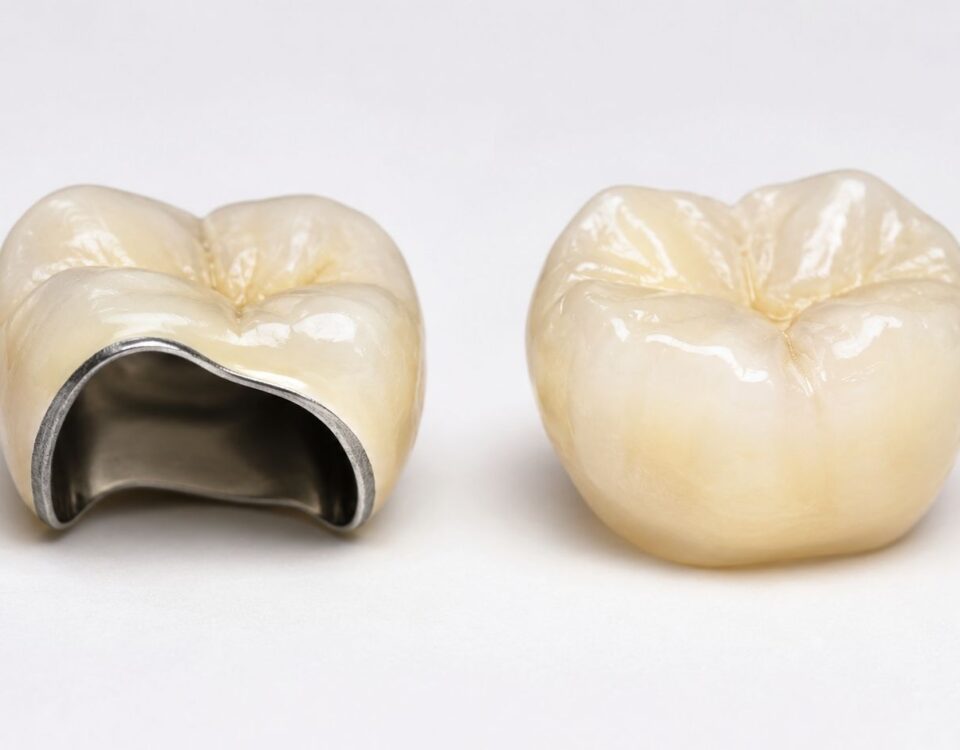
Veneers are thin porcelain shells bonded to the front of teeth. They're usually chosen when the issue is not just color, but also shape, spacing, minor misalignment, or worn enamel. This is why veneers can create such a dramatic cosmetic change. They don't just whiten the smile. They can redesign how the visible teeth look.
They're also one of the more durability-focused cosmetic options. An industry summary reports a 94.4% 5-year survival rate and 82.9% viability at 20 years for porcelain laminate veneers, as cited in this veneers durability summary.
Veneers are not the right answer for every patient. They require careful planning, case selection, and material choice. But for the right person, they can address multiple concerns at once in a way whitening alone cannot.
Invisalign and cosmetic orthodontics
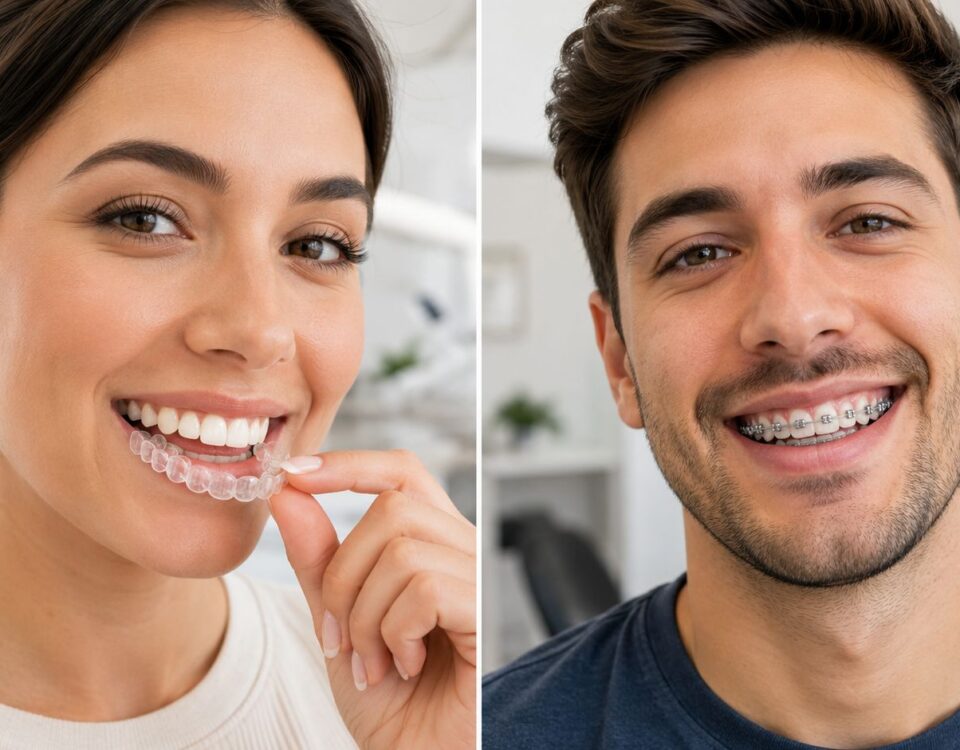
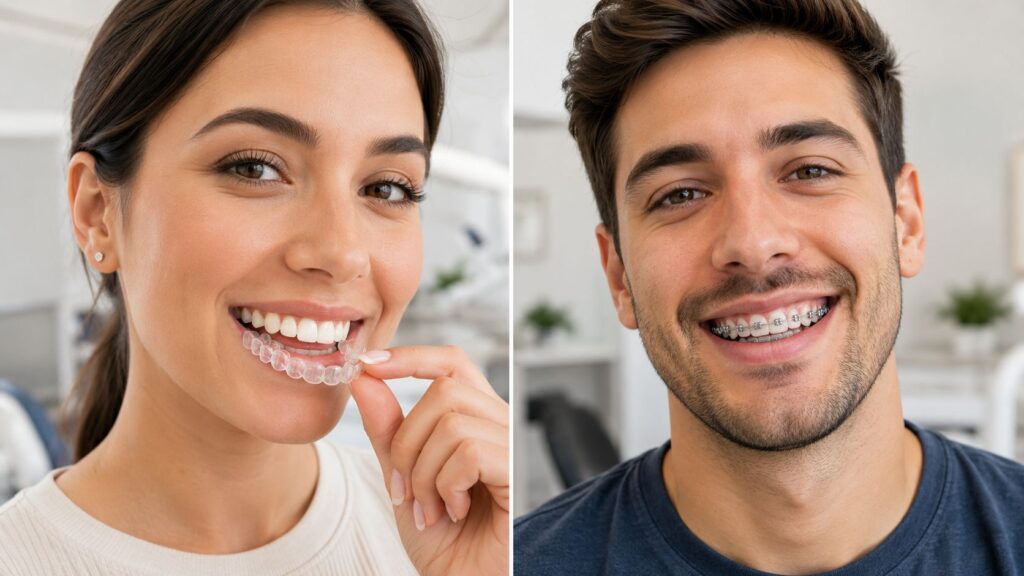
If your teeth are healthy but not where you want them to be, moving them may make more sense than covering them. Invisalign uses a series of clear aligners to gradually shift teeth into better positions. Patients often like it because it's discreet and fits adults who want a more subtle orthodontic option.
Invisalign is commonly considered for:
- Mild crowding in the front teeth
- Small gaps between teeth
- Teeth that tilt or rotate
- Alignment concerns that make the smile look uneven
The key benefit is that it corrects position rather than masking it. If spacing or crowding is the root issue, orthodontic movement often creates a more conservative long-term result.
Dental implants
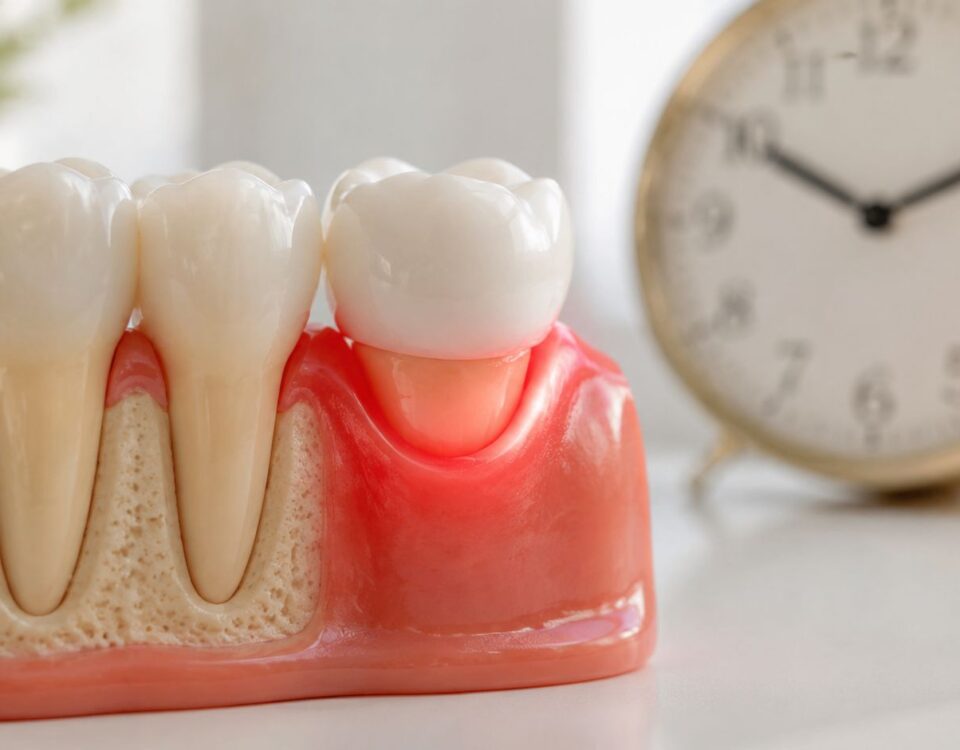
When a tooth is missing, cosmetic dentistry and restorative dentistry overlap. A gap affects appearance, but it can also affect chewing, speech, and the way nearby teeth function. A dental implant replaces the missing tooth root and supports a restoration above it.
For many patients, implants matter because they restore both the look of a full smile and the stability of the bite. They're especially useful when the question isn't “How do I make this tooth prettier?” but “How do I replace the tooth that's gone?”
Bonding and cosmetic white fillings
Bonding is one of the most useful options for small changes. A tooth-colored resin is shaped directly on the tooth to improve appearance. It can repair a chip, soften an irregular edge, or close a minor gap. Cosmetic white fillings can also replace older visible restorations with something that blends in more naturally.
This category works well when the problem is limited and specific. It's often more conservative than veneers and faster than orthodontics, though it may not be the best choice for larger smile redesigns.
If you only dislike one small feature of your smile, a smaller treatment may be the smartest treatment.
Which treatment fits which goal
| Procedure | Best For | Typical Timeline | Durability |
|---|---|---|---|
| Teeth Whitening | Surface stains or darker natural tooth color | Often short-term treatment or a series of applications | Varies by stain type, habits, and maintenance |
| Porcelain Veneers | Color, shape, worn edges, minor spacing concerns | Usually planned over multiple visits | Long-lasting in well-selected cases |
| Invisalign | Mild crowding, gaps, and alignment concerns | Gradual process over time | Depends on retention and follow-through |
| Dental Implants | Missing teeth | Multi-step restorative process | Built for long-term replacement |
| Bonding | Small chips, uneven edges, minor gaps | Often completed quickly | Useful but generally more maintenance-sensitive than porcelain |
If you'd like to see how several treatments can work together, the smile makeover overview from Dr. Skotzko shows how cosmetic planning can combine whitening, veneers, bonding, Invisalign, or restorative care into one coordinated result.
How to Choose the Right Cosmetic Treatment for You
The query Cosmetic Dentistry Near Me usually isn't asking only about distance. They're asking which treatment fits their smile. That distinction matters. Guidance on the right option is often more valuable than a short drive.
A practice-focused discussion from Orange Grove Dental on cosmetic dentistry decisions points out that people searching locally often want help deciding when whitening, bonding, veneers, or Invisalign makes the most sense for concerns like stained teeth, gaps, worn edges, or mild crowding.
If your main goal is a brighter smile
Start with the source of the color change. If your teeth are generally healthy and the problem is stain, whitening may be the most conservative first move. If the discoloration is deep, uneven, or paired with shape issues, whitening alone may leave you underwhelmed.
A good way to think about it is this:
- Whitening changes shade
- Veneers can change shade and visible tooth form
- Bonding can help small isolated spots, but it isn't a full-smile whitening treatment
If you want your natural teeth lighter, whitening is the logical starting point. If you want your smile to look brighter and more symmetrical at the same time, veneers may fit better.
If you want to fix chips, worn edges, or uneven shapes
Bonding and veneers are often compared. Bonding is useful for smaller corrections. A minor chip on one front tooth or a slight edge imbalance may be handled with a conservative bonded repair.
Veneers tend to make more sense when several front teeth need to match, when the enamel is worn, or when color and shape both need improvement. The larger the cosmetic change, the more planning matters.
Choose the treatment that matches the scale of the problem. Small issue, small solution. Bigger redesign, more comprehensive solution.
If you want to close gaps or straighten front teeth
A lot of patients assume veneers are the answer for every spacing problem. Sometimes they are. Sometimes they aren't. If teeth are out of position, Invisalign may address the underlying alignment rather than making the teeth appear straighter by changing their front surfaces.
That doesn't mean veneers or bonding are wrong for gaps. For tiny spaces or shape-related spacing, either may be appropriate. The deciding question is whether the issue is shape, position, or a mix of both.
If you're missing a tooth
Once a tooth is gone, the decision shifts. The conversation is no longer just cosmetic. It becomes restorative too. An implant may be appropriate when you want a fixed replacement that supports function as well as appearance.
If your smile concern includes a missing tooth, the plan should consider bite stability, surrounding teeth, and long-term maintenance, not just what fills the space visually.
Questions worth asking yourself before you book
These answers help narrow the field quickly:
- What bothers you most? Color, shape, spacing, or a missing tooth?
- Do you want the most conservative option first? Many patients do.
- Are you looking for a subtle change or a dramatic one?
- Is your goal fast improvement, long-term durability, or both?
- Do you want to preserve your natural tooth shape if possible?
If you can answer those questions, you're already much closer to the right treatment path.
Your Smile Makeover Journey in Cornelius
Most patients feel better once they know what the process looks like. Uncertainty creates anxiety. A clear sequence makes treatment feel manageable.
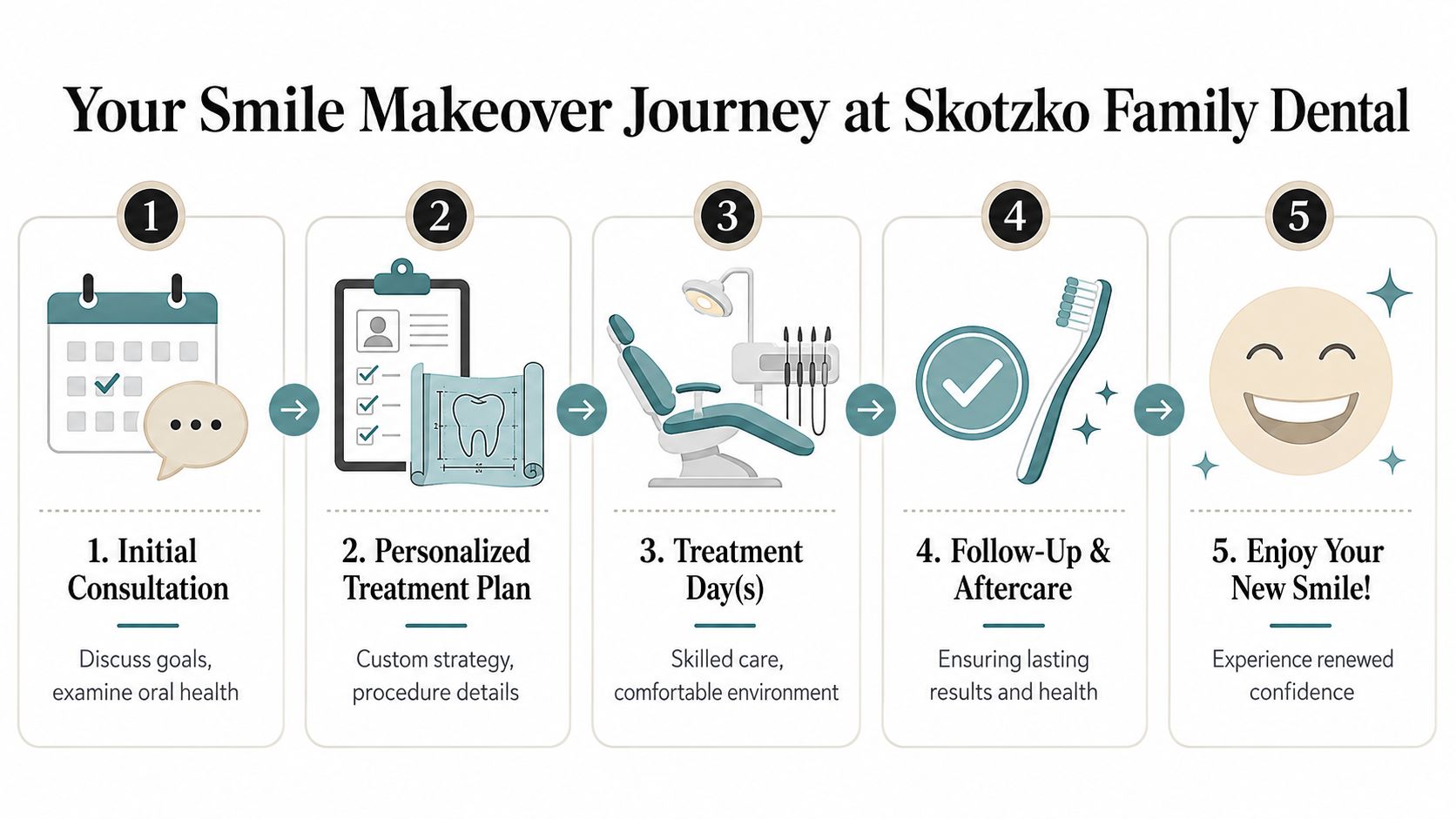
The first visit
The first appointment is a conversation as much as an exam. A patient might say, “I don't like how dark my teeth look,” only to discover that the deeper frustration is uneven edges or crowding that makes the smile look shadowed. Another patient may ask for veneers and learn that a more conservative option could achieve the result they want.
That early visit is where goals become specific. Which teeth bother you? What photos of your smile do you dislike? Are you hoping for natural refinement or a more dramatic makeover? Good planning starts there.
Building the plan
After the exam, the next step is matching your goals to what your teeth can support safely. Sometimes the plan is simple. Whitening first, then a small bonded repair on one tooth. Other times it's more layered. Invisalign to move teeth into better positions, followed by whitening or contouring.
This is also the stage where digital imaging and smile-design tools can help. They make the treatment less abstract. Instead of trying to imagine changes from a verbal description, patients can understand the shape and sequence of the plan more clearly.
A good cosmetic plan should feel understandable. If you leave confused, you probably need a better explanation before moving forward.
Treatment day or treatment days
Cosmetic care isn't always completed in one appointment. Whitening may be short and focused. Invisalign unfolds gradually. Veneers and implant treatment usually involve several steps. That doesn't make the process complicated. It means each procedure has its own rhythm.
During treatment, comfort matters. Patients usually want to know two things right away. “Will this hurt?” and “How long will I be here?” Those are reasonable questions, and they should be answered directly before anything begins.
Follow-up and maintenance
Once the cosmetic work is done, the job isn't over. Results last best when patients know how to care for them. Whitening may need touch-ups. Bonding may need polishing or occasional repair over time. Veneers and implants still require healthy gums, daily home care, and regular dental visits.
A smile makeover isn't a one-time transaction. It's part of your ongoing oral health.
What patients often notice afterward
The first change many people mention isn't purely visual. It's behavioral. They stop hiding their teeth. They smile normally in photos. They speak without thinking about one tooth they used to fixate on. The treatment may be dental, but the result often shows up most in confidence and ease.
Choosing Skotzko Family Dental for Your Cosmetic Needs
For cosmetic work, trust matters just as much as technique. You want clear recommendations, honest expectations, and a setting where you don't feel rushed into a treatment that isn't right for you.
Why diagnostic judgment matters
One of the biggest reasons to choose a local cosmetic provider carefully is that many smile concerns look similar at first glance but need different treatment. A whitening case isn't always a whitening case. A “crooked tooth” issue may really be a shape issue. A veneer request may be better handled with aligners, bonding, or restorative treatment.
That's especially true with whitening. As noted in the earlier clinical review, whitening results depend on peroxide chemistry, concentration, and stain type. In-office options use stronger formulations for more predictable shade change on intrinsic discoloration, while home systems are often better suited to extrinsic staining. That makes diagnosis important, not optional.
What a patient-centered experience looks like
A community practice should make cosmetic dentistry feel approachable. That means listening first, explaining treatment in plain language, and showing patients what each option can and can't do. It also means respecting the fact that not everyone wants the same kind of smile. Some patients want a polished but natural look. Others want a more noticeable transformation.
One useful place to get a feel for the setting and approach is the office page for Dr. Skotzko's practice in Cornelius.
A typical patient story might look like this. One person comes in asking for veneers because of a single chipped front tooth, then learns bonding may be enough. Another asks for whitening but discovers that alignment is the larger issue and chooses Invisalign first. A third wants to replace a missing tooth and needs a restorative plan that also improves the appearance of the smile line. These are different problems, and they deserve different answers.
Here's a closer look at the practice environment and philosophy:
A local option for multiple cosmetic paths
In Cornelius, Skotzko Family Dental Clinic provides cosmetic services that include whitening, veneers, cosmetic white fillings, space closing, dental implants, and Invisalign, along with general and restorative care. That combination matters because patients don't always fit neatly into one category. Sometimes the right cosmetic answer is connected to bite support, tooth repair, or replacement planning.
For many people, the deciding factor isn't finding the office closest to home. It's finding a dentist who can sort through the choices clearly and recommend the least aggressive option that still meets the goal.
Common Questions About Cosmetic Dentistry in Cornelius
How much does cosmetic dentistry cost?
The cost depends on the treatment and how many teeth are involved. Whitening, bonding, Invisalign, veneers, and implants each require different materials, time, and planning. The more helpful question is usually not “What's the cheapest option?” but “Which option solves my problem well?”
Are cosmetic dental procedures painful?
Many cosmetic treatments are easier than patients expect. Whitening may cause temporary sensitivity. Bonding is often straightforward. Invisalign is more about pressure than pain. Veneers and implant-related treatment require more planning, but comfort should be discussed before treatment starts. If you're nervous, say so early. That helps the team adjust the experience around you.
How long do results last?
That varies by treatment and by maintenance. Whitening can fade with time and habits. Bonding may need repair or polish over the years. Veneers can be long-lasting in the right case. Implants are built as long-term tooth replacements. The biggest factor across all of them is how well you care for your teeth and gums afterward.
What if I don't know which procedure I need?
That's normal. Most patients don't walk in with a diagnosis. They walk in with a concern. “My teeth look dull.” “I hate this gap.” “This chipped tooth stands out.” A consultation is meant to translate that concern into the right treatment path.
What should I do next?
Take photos of your smile if that helps you describe what bothers you. Write down the top one or two things you'd change if you could. Bring those thoughts to your visit. Clear goals make cosmetic planning much easier.
If you're ready to talk through your options for whitening, veneers, Invisalign, bonding, implants, or a broader smile makeover, schedule a consultation with Skotzko Family Dental Clinic. A thoughtful cosmetic plan can make your next step feel clear, practical, and achievable right here in Cornelius.