
How to Keep Teeth White: A Cornelius Dentist’s Guide
May 30, 2026
How to Clean Between Teeth: A Cornelius Dentist’s Guide
June 1, 2026
A lot of people brush every day and still wonder if they're doing enough. Their teeth look fairly clean, their breath seems fine, and yet they still hear at a checkup that plaque is building up along the gumline or between the teeth.
That's why the best way to clean teeth isn't a single trick or one perfect product. It's a simple system that fits your mouth, your habits, and any real-world challenges like sensitivity, crowded teeth, braces, or dental work. When patients in Cornelius ask what works at home, the answer is usually reassuring. Good oral care is less about doing something fancy and more about doing the right things consistently.
Your Guide to a Healthier Smile in Cornelius NC
A healthy smile changes more than appearance. It affects comfort, confidence, and how easy it feels to eat, talk, and go through the day without thinking about your teeth. A complicated routine isn't typically required. What's needed is a routine that can be repeated every day without guessing whether it's “good enough.”
That uncertainty is common. Many people brush regularly but rush through it, skip the spaces between their teeth, or use tools that don't fit their needs very well. The gap between intention and technique is often bigger than people realize.

One reason this matters is that home care habits are often inconsistent. A global summary reports that over 80% of people say they brush twice daily, but only about 7% floss every day. In the United States, the average brushing time is only about 45 seconds, not the recommended 2 minutes. You can review those figures in these dental hygiene statistics.
Why simple routines work better
The strongest routines are practical. They don't depend on motivation alone. They use the same order every day, the same basic tools, and a method that covers all surfaces instead of just the front teeth you can see in the mirror.
For families in Cornelius, that's good news. You don't need an elaborate shelf of products to protect your smile. You need a routine that's complete, gentle, and realistic enough to stick.
Good oral hygiene should feel manageable. If a routine is too complicated to repeat, it usually doesn't last.
What patients really need to know
The most helpful dental advice explains the “why,” not just the steps. Once you understand where plaque collects and why certain areas get missed, daily care gets easier. You stop brushing harder and start brushing smarter.
That's the approach many families appreciate from a local dental home. Clear guidance, steady habits, and small corrections over time can make a real difference in how your teeth and gums feel.
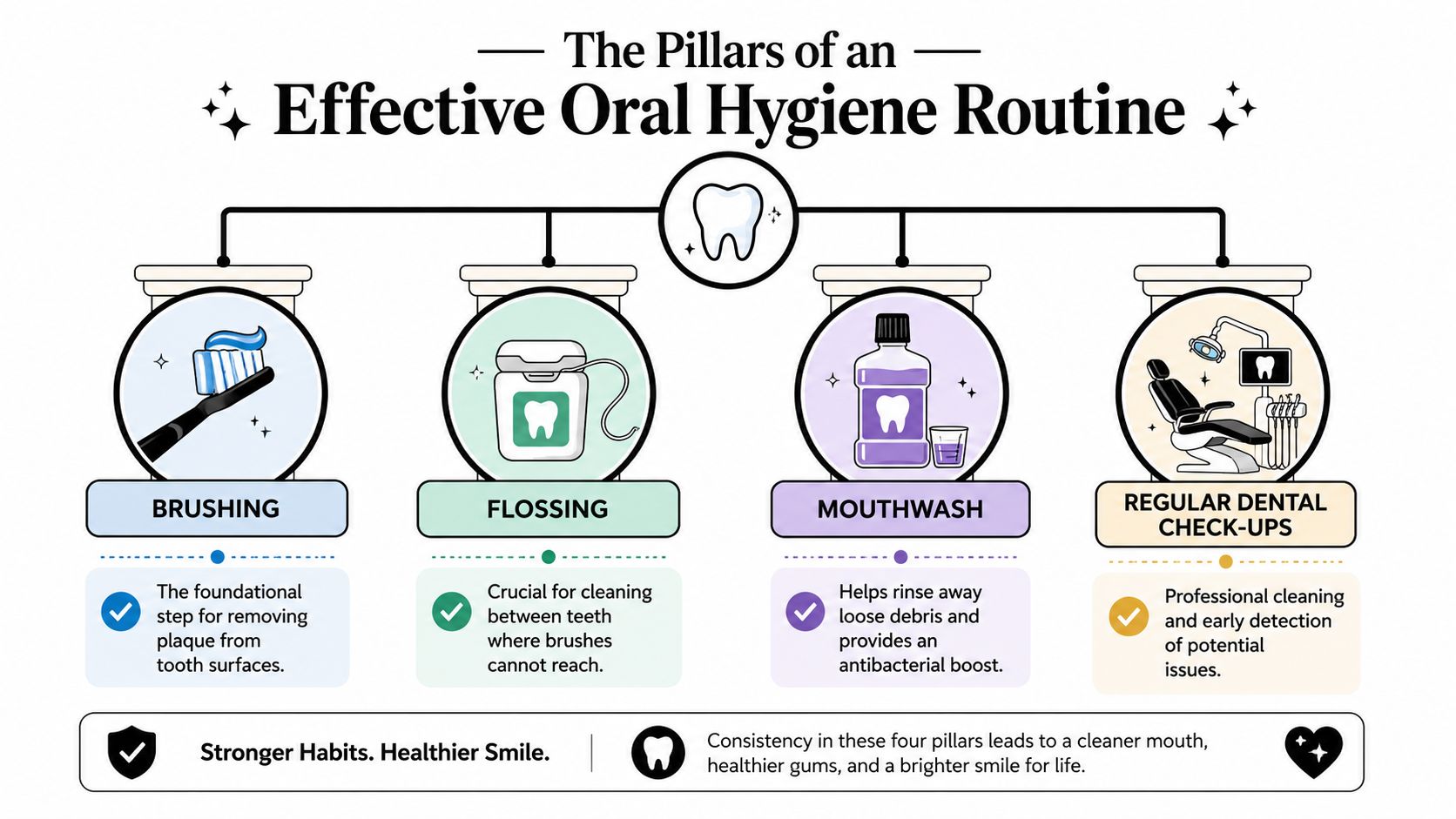
The Pillars of an Effective Oral Hygiene Routine
The foundation of a cleaner mouth is understanding what brushing can and can't do. A toothbrush does important work on the visible surfaces of the teeth, but it doesn't clean every area where plaque likes to collect.
Clinicians at the University of Colorado Anschutz note that brushing alone cleans only about 60% of tooth surfaces, which means the remaining 40% needs attention from an interdental cleaner. Their explanation of why flossing is essential is covered in this article on brushing and flossing.
Brushing is the base, not the whole routine
A soft-bristled toothbrush and fluoride toothpaste are the starting point. Brushing removes plaque from the outer, inner, and chewing surfaces of the teeth. It also spreads fluoride where it can help protect enamel.
But brushing doesn't reliably reach the tight spaces between teeth. That's the area many people skip, especially when they feel tired or rushed.
Cleaning between teeth is not optional
Interdental cleaning matters because plaque doesn't stay neatly on the front of the teeth. It collects where the toothbrush bristles can't slide in well. That's why daily flossing, or another between-teeth cleaner, is part of a complete routine rather than an extra credit step.
A strong home-care plan usually includes:
- A soft brush: Gentle bristles clean effectively without encouraging aggressive scrubbing.
- Fluoride toothpaste: This supports enamel while you remove plaque.
- An interdental cleaner: Floss, a floss holder, an interdental brush, or a water flosser can all play a role depending on your mouth.
- Professional preventive care: Home care works best when paired with preventive dental care and regular cleanings.
Practical rule: If your routine only involves brushing, it's incomplete.
The goal is full coverage
People often focus on freshness, foam, or how clean their teeth feel with their tongue. Those signals can be misleading. The actual goal is consistent plaque removal from every surface you can reach at home, especially the gumline and the spaces between teeth.
That's what makes the best way to clean teeth a complete routine, not a single tool.
Your Perfect At-Home Dental Care Regimen
You finish getting ready for bed, brush for a minute while thinking about tomorrow, rinse, and call it good. That routine feels productive, but the spots that usually cause trouble are often the ones people rush past. A better home-care plan is not more complicated. It is more consistent.
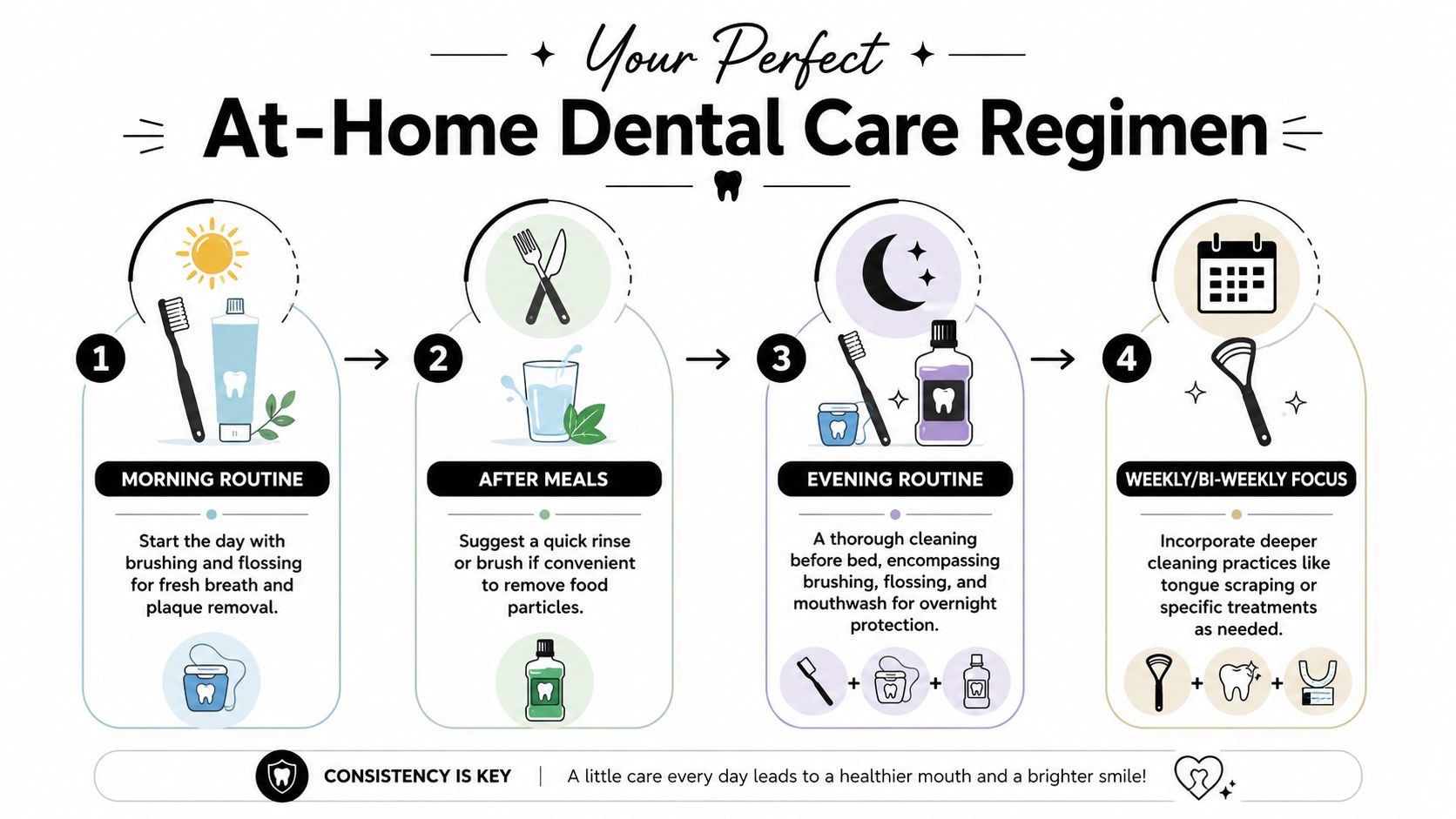
A solid routine has a simple order. Clean between the teeth. Brush carefully. Clean the tongue. Add a rinse only if it serves a specific purpose. That sequence helps remove plaque first, then lets fluoride stay in contact with the tooth surfaces you just cleaned.
Mastering your brushing technique
Brushing works best when it is gentle and methodical. Use a soft-bristled toothbrush and fluoride toothpaste twice a day. Angle the bristles toward the gumline and guide them with short strokes so they clean where the teeth and gums meet, rather than skimming only the middle of the tooth.
I usually recommend picking one starting point and following the same path every time. Go around the outside surfaces, then the inside surfaces, then the chewing surfaces. That fixed pattern matters because people who bounce around their mouth tend to miss the same areas day after day.
Pay extra attention to the places that collect plaque quickly:
- Back molars: Deep grooves and hard-to-see back surfaces are easy to miss.
- Gumline: Plaque collects where the bristles need to be angled, not scrubbed flat.
- Inside of the lower front teeth: These spots often get a quick pass instead of a careful one.
- Edges around dental work: Crowns, bridges, implants, and orthodontic attachments need detail work around the margins.
Use light pressure. If the bristles are splaying out, the brush is doing less cleaning and your gums are taking more abuse.
A quick visual can help you see how a consistent routine fits into a normal day.
Clean between your teeth before you brush
Sequence makes a real difference. A dentist interview from the University of Utah advises flossing first, then brushing, and also stresses that bedtime brushing is the most important cleaning of the day. Their explanation is practical. Removing debris from between the teeth first gives toothpaste better access to those surfaces afterward. You can read that advice in this dentist's guide to brushing technique.
For some patients, traditional floss is the best fit. For others, it is the reason they avoid the task altogether. If you have tight contacts, braces, a bridge, implants, or limited hand dexterity, your ideal routine may include a floss holder, threader, interdental brush, or water flosser instead. The best system is the one you can repeat well every day.
If you use string floss, slide it gently along the side of each tooth and curve it around the tooth surface. Snapping floss straight into the gums can make the routine uncomfortable, and uncomfortable routines do not last.
Don't ignore your tongue and cheeks
The tongue holds onto bacteria and food residue, especially toward the back. A few gentle passes with your toothbrush or a tongue cleaner can reduce coating and help with breath.
The cheeks do not need scrubbing. A good rinse after brushing and tongue cleaning is usually enough to clear away loosened debris and leave the mouth feeling cleaner.
Where mouthwash fits
Mouthwash has a supporting role. It does not remove plaque stuck at the gumline or between teeth, so it should come after the main cleaning steps, not in place of them.
The right rinse depends on the mouth in front of you. A patient with dry mouth may need something different from a patient with gingivitis, sensitivity, braces, or a lot of cavities. That is why the best way to clean teeth is not one rigid formula. It is a personalized routine built around your risks, your dental work, and what you will keep doing. If you are not sure what belongs in your lineup, Dr. Skotzko can help you fine-tune a routine here in Cornelius that fits your life and keeps your smile healthy.
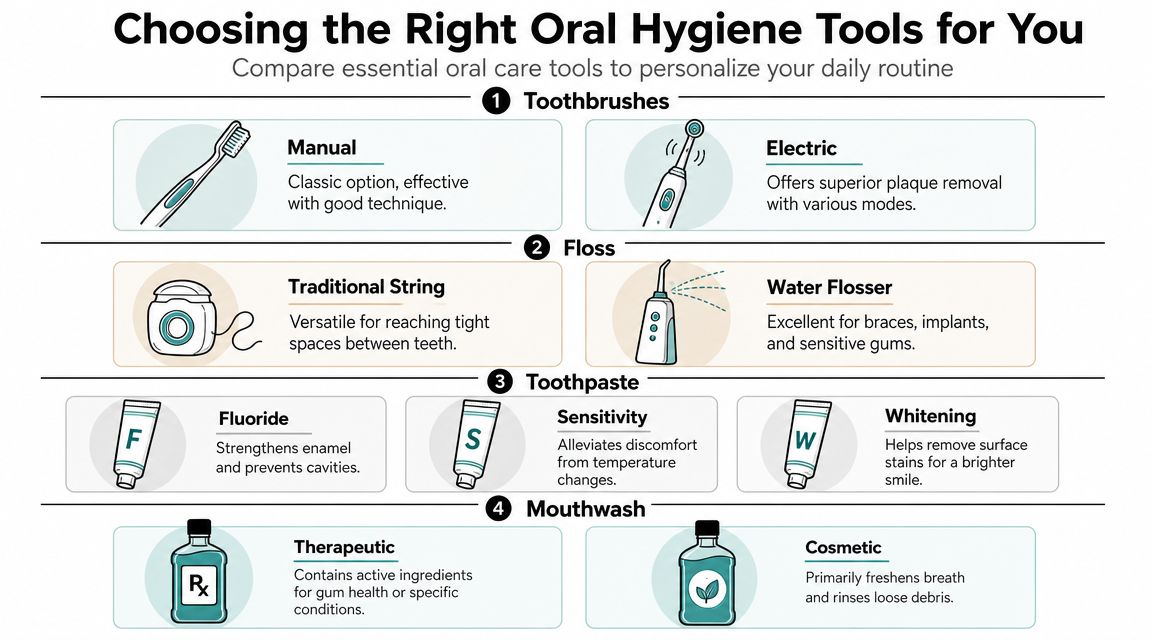
Choosing the Right Oral Hygiene Tools for You
No single tool is perfect for every patient. The best setup is the one that matches your teeth, your hands, your dental work, and the spots you tend to miss.
Manual brush or electric brush
A manual toothbrush can work very well if your technique is consistent and gentle. It gives you full control over angle and pressure, and many people do well with it for years.
An electric toothbrush can be helpful if you tend to rush, scrub too hard, or have trouble covering every area evenly. The built-in motion can make the routine easier to repeat with the same quality each day.
Here's a practical comparison:
| Tool | Often works well for | Main trade-off |
|---|---|---|
| Manual toothbrush | People with good technique and steady habits | Easy to rush or press too hard |
| Electric toothbrush | People who want more help with consistency | Costs more and still requires proper positioning |
Which between-teeth cleaner makes sense
Personalization is paramount. Cleveland Clinic guidance notes that many people struggle with traditional floss because of tight contacts, crowded teeth, or braces, and that floss threaders, floss holders, interdental brushes, and water flossers are legitimate alternatives for daily cleaning. Their overview is available in this guide to brushing and oral hygiene tools.
That matters because too many people assume floss is the only “right” answer. In real life, the right tool is the one you can use thoroughly and consistently.
Consider these situations:
- Tight contacts between teeth: Traditional floss may still be the cleanest fit if it slides through without shredding.
- Crowded teeth or limited dexterity: A floss holder can make daily cleaning much easier.
- Braces or fixed wires: Threaders and water flossers often make access more realistic.
- Wider spaces between teeth: Interdental brushes can clean those areas more directly.
If floss snaps, shreds, or won't pass easily, don't force it repeatedly. That's often a sign to switch tools and ask for a more tailored recommendation.
Toothpaste and rinse choices
For most adults, fluoride toothpaste is the default choice because it supports enamel while you brush. Some people also benefit from sensitivity toothpaste or a whitening toothpaste for surface stains. The right option depends on your goals and how your teeth respond.
For patients who want one-on-one guidance, Dr. Skotzko Family Dental Clinic can review brushing and flossing technique during preventive visits and help match tools to issues like crowding, sensitivity, Invisalign attachments, implants, or bridgework.
Specialized Cleaning for Every Stage of Life
Daily care changes as your mouth changes. A child learning to brush, a teen with aligners, and an adult cleaning around implants do not need identical instructions. The best way to clean teeth is still built on the same principles, but the details should match the situation.
Helping children build good habits
For younger children, the goal is consistency before perfection. Parents often do best when they make brushing part of the same morning and bedtime rhythm every day. Children usually miss the back teeth and gumline because they focus on the front teeth they can see.
A simple family approach works well:
- Keep the routine predictable: Same sink, same order, same time of day.
- Use gentle guidance: Kids respond better to coaching than correction.
- Check the back teeth: Parents should look, even if the child brushed independently.
In family dentistry, the biggest win is turning oral care into a normal part of the day instead of a negotiation.
Braces and Invisalign need a more deliberate routine
Orthodontic care creates extra edges, attachments, and spaces where food can linger. Patients with braces often need more patience around brackets and wires. Patients using Invisalign need to be especially attentive before trays go back in, because trapped debris can sit against the teeth.
What helps most is slowing down and using a repeatable pattern. Clean around every attachment, along the gumline, and behind the last molars. If standard floss is frustrating, this is one of the clearest times to switch to threaders, holders, or a water flosser rather than giving up on interdental cleaning.
Cleaning around implants, bridges, and dentures
Restorative dentistry changes the shape of the areas you need to clean, not the importance of cleaning them. Dental implants, bridges, partials, and dentures all create surfaces and edges that need careful attention every day.
Patients often do well when they focus on the margins, meaning the places where the restoration meets the gums or neighboring teeth. Those edges collect plaque more easily than many people expect. Around bridges and implants, a water flosser, floss threader, or another specialized aid may be much easier than standard floss alone.
A personalized routine matters here. The exact tool often depends on the type of restoration, how much space is available, and how easy it is for you to maneuver around it comfortably.
When to See Your Cornelius Dentist for a Professional Cleaning
You brush at night, clean between your teeth, rinse, and still wake up with a mouth that feels coated again. That usually means the problem is no longer just daily plaque. Once buildup hardens, home care cannot remove it well, no matter how diligent you are.
Professional cleanings fill that gap. They remove tartar, let your dental team check areas that are easy to miss at home, and give you a chance to adjust your routine before a small problem turns into gum irritation, decay, or both.
Signs your routine may need help
Some signs are easy to overlook because they come and go. If they keep returning, it is time for a closer look.
Watch for patterns like these:
- Bleeding when brushing or cleaning between teeth: Repeated bleeding often points to gum inflammation, not just “brushing too hard.”
- Persistent bad breath: Odor can come from plaque and tartar sitting in places your brush and floss are not reaching well.
- Tenderness near the gums: This can happen with inflammation, gum recession, or a cleaning technique that needs adjustment.
- A toothbrush with frayed bristles: A worn brush does a poorer job of cleaning and can be rough on the gums. If the bristles are splayed, replace it.
I also tell patients to pay attention to what feels different, not just what hurts. If one area always traps food, if one side feels rough no matter how long you brush, or if sensitivity keeps flaring up, those details help us figure out whether you need a new tool, a different technique, or a cleaning sooner than planned.
What a professional cleaning adds
A good cleaning does more than polish teeth. Your hygienist removes hardened buildup, measures gum health when needed, and looks for patterns that explain why home care may not be working as well as it should.
That matters because the best way to clean teeth is rarely one fixed routine for every person. A patient with crowding needs different advice than a patient with implants. A teenager with braces needs a different system than an adult with gum sensitivity. Professional visits help shape that system so it fits your mouth, your habits, and what you can realistically keep up with.
For patients looking for a dentist near you in Cornelius, NC, comfort matters too. People are more likely to stay on schedule when the visit feels clear, respectful, and responsive to their needs.
A practical partnership for long-term oral health
The healthiest smiles usually come from steady home care plus regular professional support. You handle the daily maintenance. Your dental team removes what home tools leave behind and fine-tunes the routine as your needs change.
That approach is especially helpful for children learning good habits, adults with restorative work, and anyone dealing with sensitivity, crowding, or changing gum health. At Skotzko Family Dental Clinic, those visits are also a chance to build a routine that feels manageable, not complicated. Great home care should fit into real life.