
How to Fix Crooked Teeth Without Braces
June 4, 2026
Cornelius Tooth Extraction Aftercare Instructions
June 6, 2026
Those searching for how to improve their smile aren't chasing a dramatic makeover. They're usually dealing with something more personal and familiar. Maybe you smile with your lips closed in photos. Maybe one front tooth looks darker than the others, a small chip catches your eye in the mirror, or old dental work has started to show. Sometimes the issue is bigger, like crowding, missing teeth, or wear that has built up over the years.
The good news is that smile improvement doesn't have to start with a major procedure. In many cases, the best results come from a clear sequence. Get the mouth healthy first. Fix what's bothering you most. Choose the most conservative treatment that will do the job. That approach is safer, more predictable, and usually easier to live with long term.
For families and adults in Cornelius, NC and nearby communities, that matters. A better smile should look good, feel natural, and support your overall oral health, not just cover up a problem for a few months.
A Confident Smile Starts Here in Cornelius NC
You notice it in small moments. A hand comes up before a laugh. You angle your face in photos. You keep telling yourself you will deal with that chipped edge, dark tooth, or gap later.
Smile concerns matter because they affect daily life. They also deserve a plan that fits the underlying problem, not a one-size-fits-all cosmetic answer. In practice, the best results usually come from a sequence: start with a healthy foundation, identify what bothers you most, and choose the most conservative treatment that can get you there.
Researchers and insurers have reported a clear link between smile satisfaction and self-confidence, and that lines up with what many dentists see in the chair. People often put off asking about their smile because they assume the answer will be expensive, aggressive, or purely cosmetic. Many times, it is much simpler than that. Sometimes it is not simple, and being honest about that trade-off matters too.
Small concerns deserve real solutions
A brighter, more even smile can come from very different treatments depending on the cause. Surface stain calls for a different approach than internal discoloration. A rough edge may need minor polishing or bonding, while a tooth that looks shorter than the others may point to wear, gum inflammation, or bite stress. Old fillings, grinding, and missing teeth can all change the look of a smile in ways that overlap.
That is why diagnosis comes first.
A good smile plan should answer a few practical questions before any treatment starts. What is causing the problem? What is the most conservative fix? How long should the result last? What will maintenance look like in one year or five?
A smile improvement plan works best when it matches the actual cause. Stain, wear, spacing, decay, and missing teeth may look similar from a distance, but they are not treated the same way.
What a practical roadmap looks like
A trustworthy approach usually follows a clear order:
- Start with health so decay, gum problems, and bite issues are addressed before cosmetic work begins.
- Pick conservative options first when whitening, bonding, contouring, or replacing worn dental work can give you the result you want.
- Use larger treatments carefully when alignment problems, tooth loss, or heavier wear call for Invisalign, veneers, crowns, or implants.
- Match the plan to your goals by weighing budget, timeline, upkeep, and how much change you actually want.
- Think beyond the mirror so the smile looks good, feels comfortable, and functions well long term.
That kind of roadmap helps people avoid two common mistakes. One is doing too much for a small issue. The other is trying to cover a larger health or bite problem with a quick cosmetic fix that will not hold up.
Your First Steps Toward a Brighter Smile
A patient will often tell me, "I want whiter teeth," and the first thing I notice is not the color. It is plaque along the gumline, stain collecting in the grooves, a rough edge on one front tooth, or gums that look irritated. Those details matter because the right first step is rarely the biggest treatment. It is the one that gives you a cleaner, healthier starting point and keeps later cosmetic work predictable.
If your goal is a better-looking smile, start with daily care and a close exam. Clean teeth reflect light better. Healthy gums frame the teeth better. A stable mouth also makes it much easier to decide whether you need simple maintenance, a small cosmetic touch-up, or a larger change later.
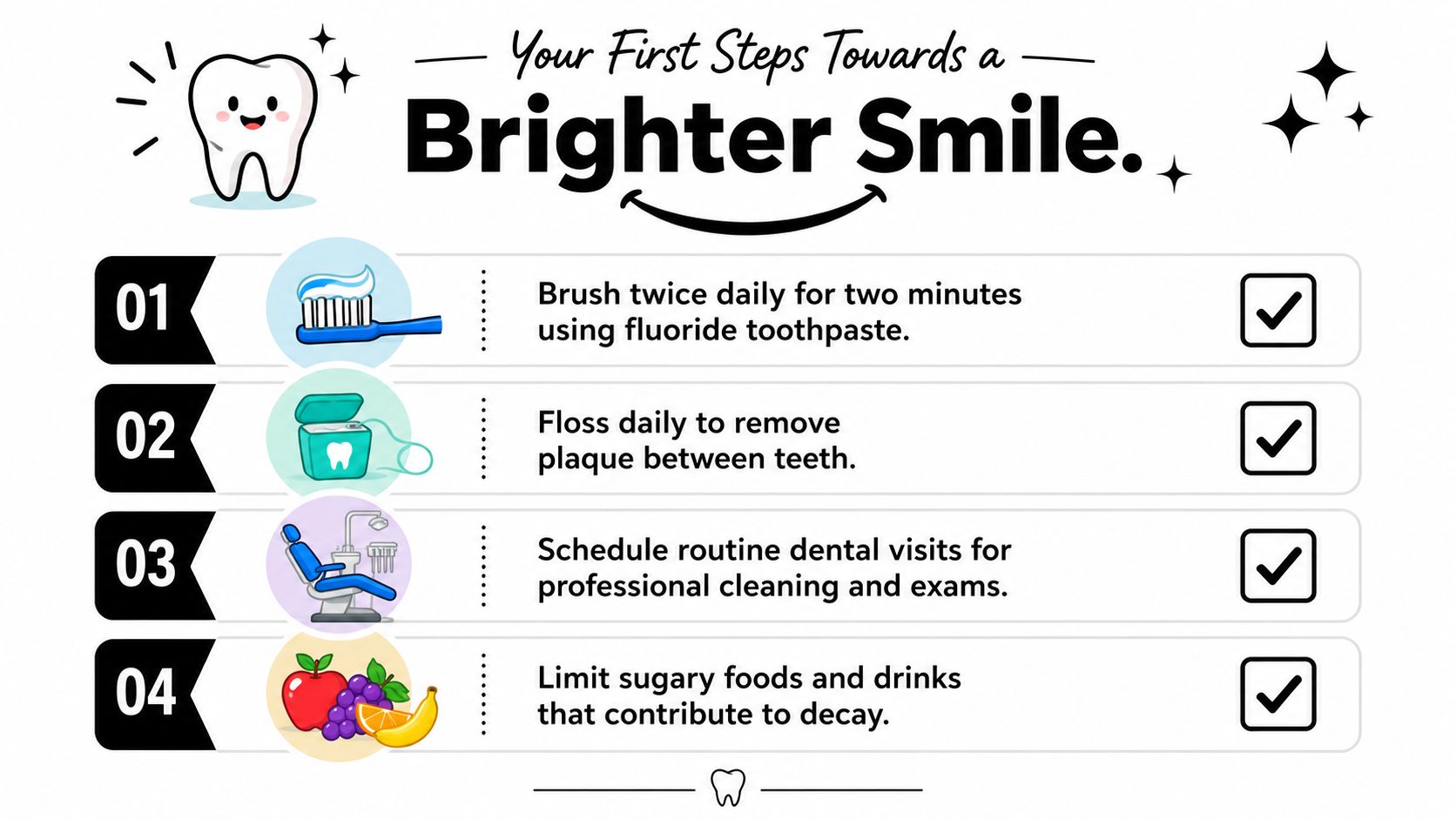
Here's the simplest version of that foundation:
Daily habits that change your smile
Small habits shape what your smile looks like over time.
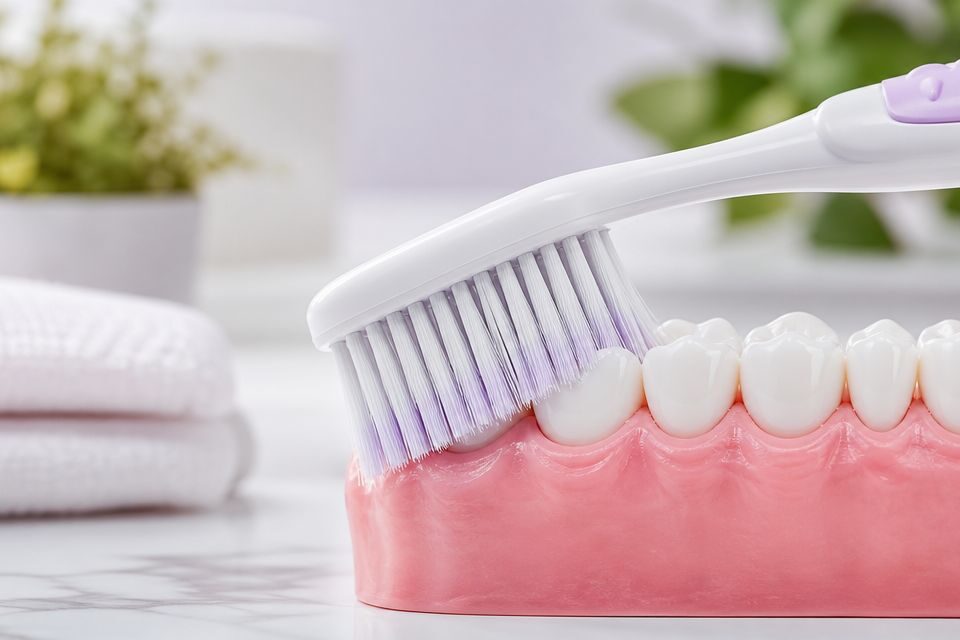
- Brush thoroughly: Brush twice a day for two minutes with fluoride toothpaste. Gentle, consistent brushing protects enamel better than hard scrubbing.
- Floss every day: Floss reaches the tight spaces where plaque builds up and gums become puffy or inflamed.
- Keep up with cleanings: Professional cleanings remove hardened buildup that home care cannot remove and give your dentist a chance to spot early wear, decay, or gum trouble.
- Watch frequent sugar exposure: Sipping soda, sweet tea, sports drinks, or coffee loaded with sugar all day keeps the teeth under repeated acid attack.
- Pay attention to stain habits: Tobacco, coffee, red wine, and some teas can darken teeth, especially when cleanings are overdue.
These steps sound simple because they are. They also make the biggest difference for many people who feel their smile looks dull.
When a small cosmetic fix is enough
Many smiles improve with one precise change, not a full makeover. A minor chip, a slightly uneven edge, or a small asymmetry can often be corrected with conservative treatment that preserves healthy tooth structure.
That is where careful case selection matters. Bonding can repair a small chip in one visit and look very natural, but it may stain or wear faster than porcelain over the years. Enamel shaping can smooth a rough or uneven edge quickly, but only when there is enough enamel to work with and the bite is not causing ongoing damage.
Those options tend to work well here:
| Concern | Conservative option | When it works well |
|---|---|---|
| Small chip on an edge | Bonding | When the tooth is healthy and the missing area is limited |
| Slightly uneven front teeth | Enamel shaping | When only a small amount of contouring is needed |
| Tiny asymmetry | Bonding or contouring | When the goal is refinement, not a major shape change |
| Rough edge after wear | Polishing or contouring | When there is enough enamel and the bite is stable |
A good plan matches the size of the problem. If you want a practical overview of cosmetic dentistry options for common smile concerns, start with the least invasive treatment that can realistically meet your goal.
What does not work well
Surface-level fixes have limits. Whitening will not repair a chipped tooth. Bonding will not solve a major bite problem. Contouring will not straighten crowded teeth or strengthen a tooth with a large crack.
People can waste time and money. A treatment may sound simple, but if the underlying issue is tooth position, heavy wear, untreated decay, or a missing tooth, the result may not last or may never look quite right in the first place.
For patients in Cornelius who want a sensible place to start, Skotzko Family and Cosmetic Dentistry offers preventive care, cosmetic white fillings, whitening, veneers, Invisalign, and restorative options, which makes it possible to build a plan from the smallest fix to more involved treatment when needed.
Professional Whitening and Veneers for a Dazzling Look
Once the teeth and gums are healthy, the next question is usually about appearance. For many adults, the decision comes down to two paths. Do you want to brighten the teeth you already have, or do you want to change the shape, color, and overall look more dramatically?
That's the difference between whitening and veneers.
When professional whitening makes sense
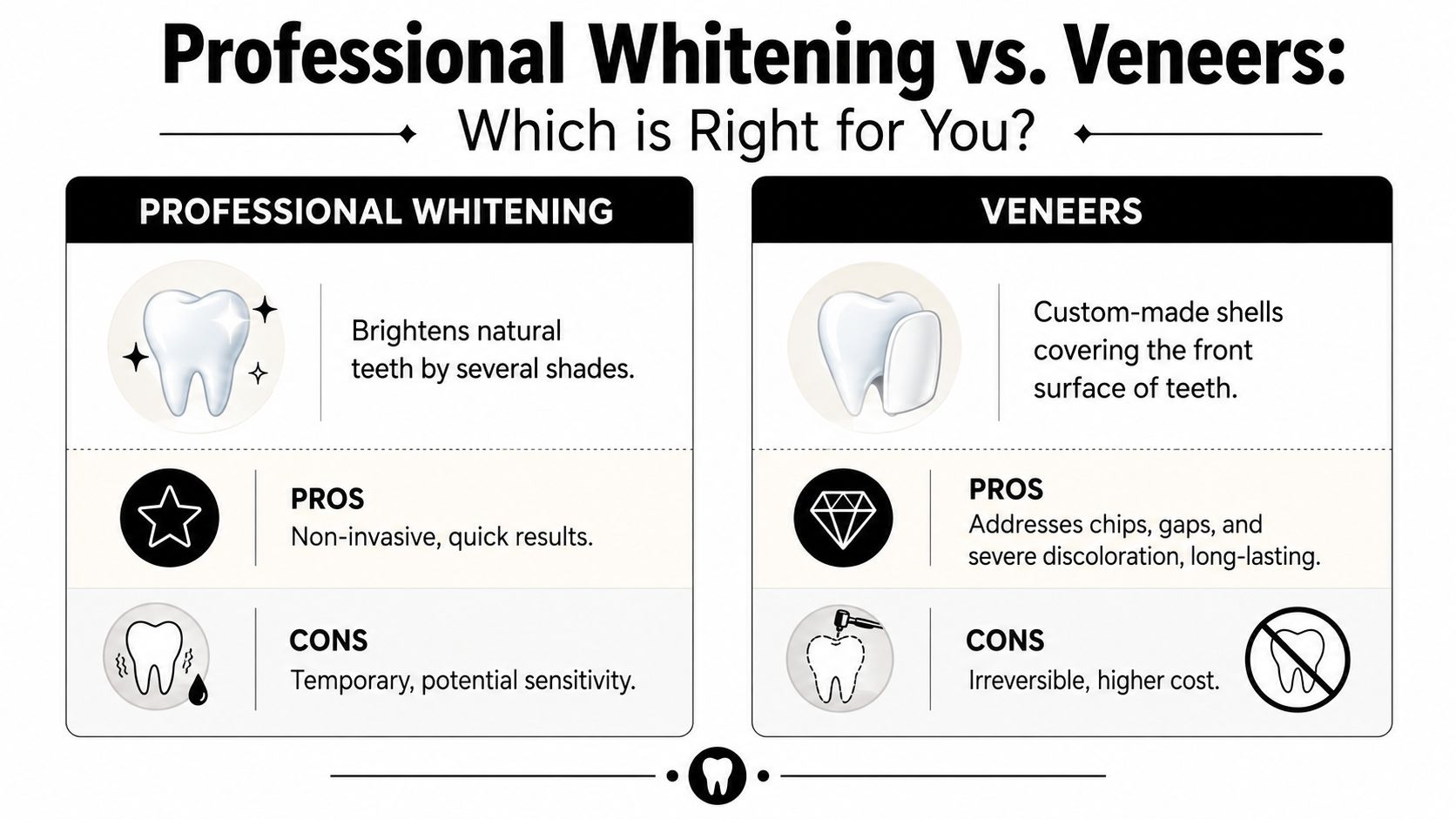
Whitening is the better fit when your teeth are healthy, you like their general shape, and your main complaint is discoloration. It's a color correction treatment, not a shape correction treatment.
Professional whitening is usually more controlled than over-the-counter strips or one-size-fits-all trays. The strength, fit, and timing can be adjusted for your teeth, which helps reduce uneven results. It also gives your dentist a chance to check whether the discoloration is the type that responds well to whitening at all.
Whitening tends to be a good option if you have:
- General yellowing or surface stain
- Healthy enamel with no major cracks or untreated decay
- Good tooth shape already
- A short timeline before an event or photo-heavy season
It's less useful when the issue is a chipped edge, a dark internal stain that won't lift well, a misshapen tooth, or visible spacing.
When veneers are the better choice
Veneers do more than brighten teeth. They can change the visible front surface of a tooth to improve color, shape, size, and balance. That makes them useful when the problem isn't just shade.
People often consider veneers when they want to address several concerns at once, such as:
- Chips that keep drawing attention
- Teeth that look short, worn, or uneven
- Stubborn discoloration
- Small gaps or asymmetry
- A more uniform smile line
Veneers can be an excellent option, but they aren't the right answer for every patient. They're a bigger commitment than whitening. Planning matters. Bite matters. Gum health matters. So does making sure the patient wants a shape change, not just a brighter smile.
Side-by-side trade-offs
| Treatment | Best for | Main advantage | Main limitation |
|---|---|---|---|
| Professional whitening | Healthy teeth with stain or yellowing | Conservative and appearance-focused | Doesn't change shape, spacing, or worn edges |
| Veneers | Combined color and shape concerns | Can redesign visible tooth appearance | More commitment and careful planning required |
Whitening improves what's already there. Veneers redesign what's visible. That's why the right choice depends on your goal, not just your budget.
Why planning matters before veneers
Cosmetic treatment shouldn't start with drilling first and decision-making later. A better process begins with planning the end result before any irreversible step is taken.
A video explaining Digital Smile Design and cosmetic planning describes Digital Smile Design as a planning and communication tool that lets patients visualize the final result on photos or a digital model before treatment starts. It also explains that this is especially useful for cosmetic work like veneers, because clinicians can adjust tooth size, color, and alignment in advance. Just as important, the same source notes that active decay or gum disease should be treated first, because cosmetic fixes do not stop underlying dental issues.
That sequence protects patients from a common mistake. If a tooth really needs disease control, placing cosmetic work on top doesn't solve the problem.
A practical way to choose between them
If your teeth are healthy and you mostly want them brighter, whitening is usually the first treatment to consider. If you want a more significant change in shape, uniformity, and shade, veneers may be the better fit.
For patients considering broader appearance-focused care, the practice's cosmetic dentistry services in Cornelius outline options such as whitening, veneers, and other smile refinements.
A useful consultation for either treatment should answer a few direct questions:
- What exactly is bothering you. Color, shape, spacing, or wear?
- Is the mouth healthy enough for cosmetic treatment now?
- Can a conservative option reach your goal?
- If veneers are being considered, what result are you trying to create that whitening can't deliver?
Those questions prevent a lot of regret. So does taking a little extra time before choosing a permanent cosmetic change.
Aligning and Rebuilding with Invisalign and Implants
Some smile problems can't be solved by changing color or contour. If teeth are crowded, spaced, or biting unevenly, alignment matters. If a tooth is missing, replacement matters. These are functional issues as much as cosmetic ones, and the treatment plan should reflect that.
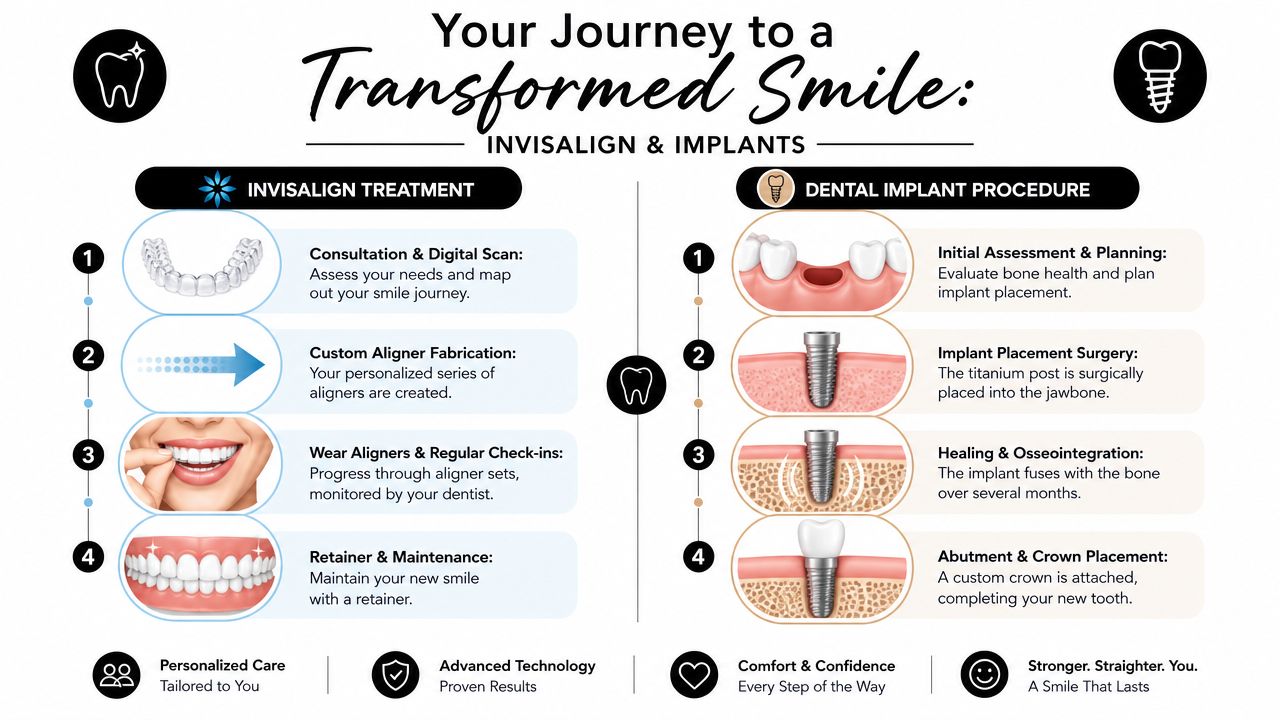
Invisalign for a straighter smile without brackets
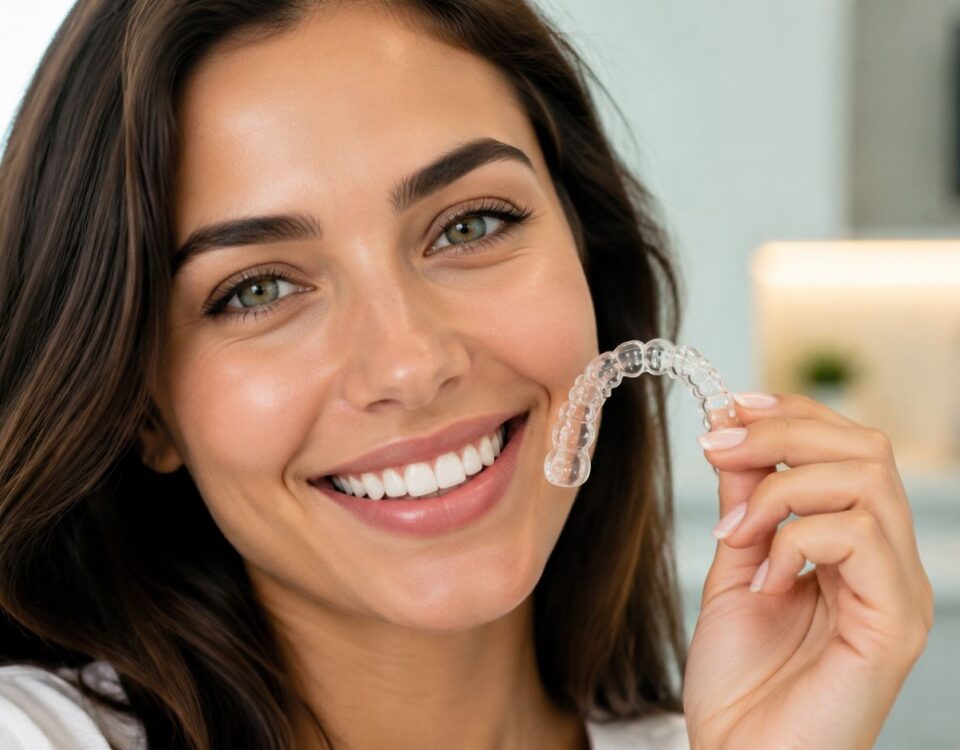
Invisalign uses a series of clear aligners to move teeth gradually. It appeals to many teens and adults because it's discreet and removable. That makes daily life easier than traditional braces for many patients, but it still requires consistency. If the aligners aren't worn as directed, the plan won't stay on track.
The process usually looks like this:
- Consultation and digital records: Your dentist evaluates your bite, crowding, spacing, and goals.
- Custom treatment planning: The tooth movement is mapped out before the aligners are made.
- Wearing each aligner series: You move through the trays in sequence and check in periodically.
- Retention: After the teeth are straightened, retainers help maintain the result.
Invisalign can be a strong option when the concern is visible crowding, small gaps, or teeth that don't line up well when you smile. It's also useful when alignment problems contribute to uneven wear.
Patients exploring clear aligners can learn more about Invisalign treatment in Cornelius.
Dental implants when a tooth is missing
A missing tooth changes more than the look of your smile. It can affect chewing, the stability of nearby teeth, and the balance of your bite. Depending on where the gap is, it may also change how full your smile appears when you talk.
A dental implant replaces the missing tooth root with a titanium post placed in the jawbone. After healing, a connector and custom crown complete the visible tooth. The result is designed to feel stable and function like a natural part of your bite.
What the implant process usually involves
Implants sound complex, but the sequence is straightforward when explained step by step.
| Step | What happens | Why it matters |
|---|---|---|
| Initial assessment | Exam, imaging, and planning | Confirms bone support, spacing, and overall suitability |
| Implant placement | The titanium post is placed in the jaw | Creates the foundation for the replacement tooth |
| Healing period | The implant integrates with bone | Builds stability before the final tooth is attached |
| Final restoration | An abutment and crown are placed | Restores appearance and chewing function |
Not every patient is an immediate implant candidate. Bone quality, gum health, smoking status, grinding habits, and the condition of neighboring teeth all affect planning. Some people need preparatory treatment first. That's normal. Careful sequencing leads to a stronger final result.
A missing tooth is never just a cosmetic issue. Replacing it is about chewing, stability, speech, and preserving the structure of the smile.
What works and what doesn't
Invisalign works well when the main issue is tooth position and the patient can wear aligners reliably. It doesn't replace restorative care for broken, infected, or missing teeth.
Implants work well when the goal is to replace a missing tooth without relying on a removable option or a bridge supported by neighboring teeth. They don't bypass the need for healthy gums and good planning.
Both treatments improve appearance, but their real value is that they rebuild function at the same time. That's a major reason they often feel more satisfying long term than a cosmetic shortcut.
How to Choose the Right Smile Improvement Option
By the time individuals start comparing treatments, they already know what bothers them. The harder part is knowing which option matches the problem without overtreating it.
A useful way to decide is to sort your concern into one of a few categories. Color. Shape. Alignment. Missing structure. Then match the treatment to the category instead of choosing based on what sounds popular.
If your main concern is color
If your teeth look dull, yellow, or stained but you like their shape, start with whitening. It's the more conservative option and often the right first move for healthy teeth.
If one or two teeth are darker in a way that doesn't respond well, or if the visible problem includes shape as well as shade, veneers or bonding may be part of the conversation. The key is identifying whether you need brightening alone or a redesign of the front surface.
If the problem is chips, wear, or small asymmetries
Minor imperfections often respond well to bonding or enamel shaping. These are especially helpful for adults who want subtle improvement without committing to extensive cosmetic treatment.
Consider a conservative fix when:
- The tooth is healthy overall
- The change needed is small
- You want an immediate visual improvement
- You prefer to preserve as much natural tooth structure as possible
If the wear is more advanced or the bite is causing repeated breakage, a larger restorative plan may make more sense.
If spacing or crowding bothers you
When the issue is tooth position, straightening is usually more predictable than trying to disguise alignment with cosmetic material. Invisalign often fits patients who want a less noticeable orthodontic option and are willing to follow the wear schedule.
A quick cosmetic fix may seem tempting for a crooked front tooth, but if the root position or bite is the underlying issue, movement is often the cleaner long-term answer.
If you have a missing tooth
That decision starts with restoration, not whitening or veneers. An implant, bridge, or removable option may be considered depending on the clinical picture, but the important point is this: the treatment needs to restore function as well as appearance.
Choose the treatment that solves the cause of the problem, not just the part you notice in photos.
Budget, timeline, and commitment matter
The right smile plan also depends on practical factors:
- Timeline: Whitening and small bonding changes can be relatively quick. Tooth movement and implants take longer.
- Budget: Conservative care may solve the problem well without moving into larger cosmetic work.
- Maintenance: Some treatments require more follow-up, polishing, retainers, or future replacement than others.
- Personal goals: Some patients want a subtle refresh. Others want a complete transformation. Neither goal is wrong.
The best consultation is a conversation, not a sales pitch. You should leave understanding what will work, what won't, and why.
Your Smile Journey with Skotzko Family Dental
Getting started shouldn't feel complicated. Most patients want three things from a dental visit. A clear explanation, a comfortable experience, and a plan that makes sense for their life.
At Dr. Skotzko Family and Cosmetic Dentistry, a smile consultation typically begins with listening first. What's bothering you. What you'd like to change. Whether your priority is health, comfort, appearance, or all three. From there, the exam and any needed imaging help clarify which treatments are appropriate now and which ones should wait until the mouth is healthier.

What patients can expect
- A personalized discussion: The plan should reflect your goals, not a generic menu of procedures.
- A conservative mindset: If a small treatment can get you where you want to go, that should be considered first.
- Clear next steps: You should know what needs to be treated, in what order, and what each choice means.
- Support for long-term care: Smile improvement lasts longer when daily hygiene and routine maintenance stay in place.
For families and adults in Cornelius, NC and nearby communities, that kind of process makes dental care feel more manageable. If you've been putting off the question of how to improve your smile because you weren't sure where to start, a straightforward consultation is often the easiest first step.
Frequently Asked Questions About Improving Your Smile
Are cosmetic dental procedures painful
Many smile treatments are more comfortable than patients expect. Whitening can cause temporary sensitivity for some people. Bonding and enamel shaping for small corrections are often well tolerated. More involved treatment such as implants or restorative work requires careful planning and local anesthesia, and comfort should be part of that conversation from the start.
Can I combine treatments
Yes. Many patients improve their smile with a sequence rather than a single procedure. For example, treatment might begin with cleaning and disease control, followed by whitening, then bonding, Invisalign, veneers, or replacement of missing teeth as needed. The right order matters.
How long do results last
That depends on the treatment and how well it's maintained. Whitening may need touch-ups over time. Bonding can require maintenance. Veneers, Invisalign results, and implants all depend on good home care, regular dental visits, and protecting the teeth from grinding or other damaging habits when relevant.
What if I don't want major cosmetic dentistry
That's common. Many people want small, natural-looking improvements, not a dramatic makeover. If your concerns are minor chips, slight unevenness, or subtle wear, conservative options may be enough.
How much does it cost to improve your smile
Cost varies widely because smile improvement can range from a cleaning and whitening plan to aligners, veneers, or implants. The useful question isn't just “What's the price?” It's “What treatment will solve my specific problem well, and what level of treatment is necessary?”
If you're ready to talk through your options, Skotzko Family Dental Clinic serves patients in Cornelius, NC and nearby communities with preventive, cosmetic, and restorative care. Schedule a consultation to get a practical smile plan that fits your goals, your timeline, and your oral health.