Best Toothbrush for Sensitive Gums: Cornelius Guide
June 3, 2026
How to Improve Your Smile: Expert Tips from Cornelius
June 5, 2026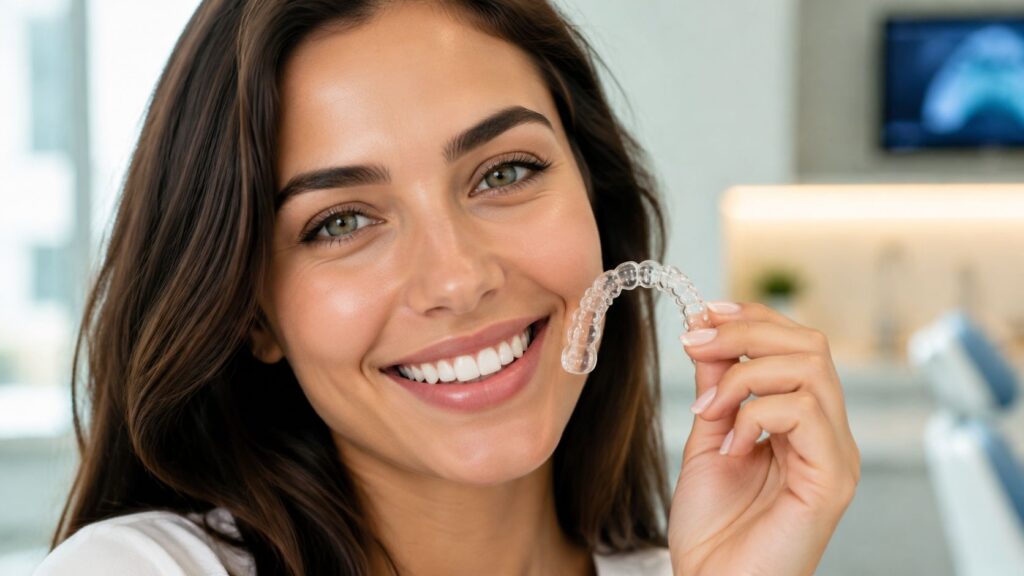
If you've been wondering how to fix crooked teeth without braces, you're probably already doing the small things people do when they don't love their smile. Smiling with lips closed. Turning slightly in photos. Noticing the same tooth every time you look in the mirror.
A lot of adults and teens want straighter teeth, but they don't want metal brackets, food restrictions, or a treatment choice that feels too obvious in daily life. That hesitation is understandable. The good news is that traditional braces aren't the only option anymore.
At Dr. Skotzko Family and Cosmetic Dentistry in Cornelius, NC, the conversation usually starts with a simple question. Do your teeth need to be moved, or do they only need to look straighter? That distinction matters more than is commonly understood, because some treatments correct alignment while others improve appearance without changing tooth position. Choosing well means thinking beyond speed and focusing on your smile, your oral health, and what will still make sense for you years from now.
A Straighter Smile Is Possible Without Braces
A common situation looks like this. Someone has one front tooth that overlaps a little, or a few teeth that seem crowded in photos. They've thought about fixing it for years, but they keep putting it off because braces feel like too much.
That delay is understandable. Individuals often aren't just worried about how treatment works. They're thinking about work meetings, family schedules, social events, and whether they'll feel self-conscious during the process. They want a straighter smile, but they want a solution that fits real life in Cornelius, NC.
What patients usually want
Individuals exploring non-braces solutions often seek some mix of the following:
- A discreet treatment that doesn't draw attention every time they talk or smile
- A practical routine that won't make eating and brushing more difficult
- A result that feels natural instead of overly done
- A plan with long-term sense rather than a quick cosmetic shortcut that creates more upkeep later
That last point matters. A smile can look straighter in more than one way, but not every option solves the same problem.
Practical rule: If your main concern is the position of your teeth, the treatment should address tooth position. If your main concern is the shape or appearance of otherwise healthy, stable teeth, a cosmetic option may be enough.
Modern dentistry gives you more than one path
Today, there are several ways to improve crooked teeth without traditional braces. Some involve orthodontic movement, such as clear aligners. Others use cosmetic masking, such as veneers or bonding. In selected cases, subtle reshaping or restorative work can also improve how a smile looks.
That doesn't mean every option is right for every patient. Mild crowding is different from a bite problem. A small gap is different from a rotated tooth. A healthy tooth that looks uneven is different from a tooth that is worn, cracked, or heavily restored.
That's why an honest evaluation matters. Good treatment planning isn't about selling a product. It's about matching the right approach to the actual problem.
A local decision, not just a cosmetic one
For many families and adults in Cornelius, this isn't just about getting a nicer photo-ready smile. It's about finding a long-term dental home and making a decision that supports oral health as well as appearance.
A straighter smile without braces is often possible. The key is choosing the option that makes sense for your teeth, your bite, your habits, and your future maintenance.
Exploring Your Options Beyond Traditional Braces
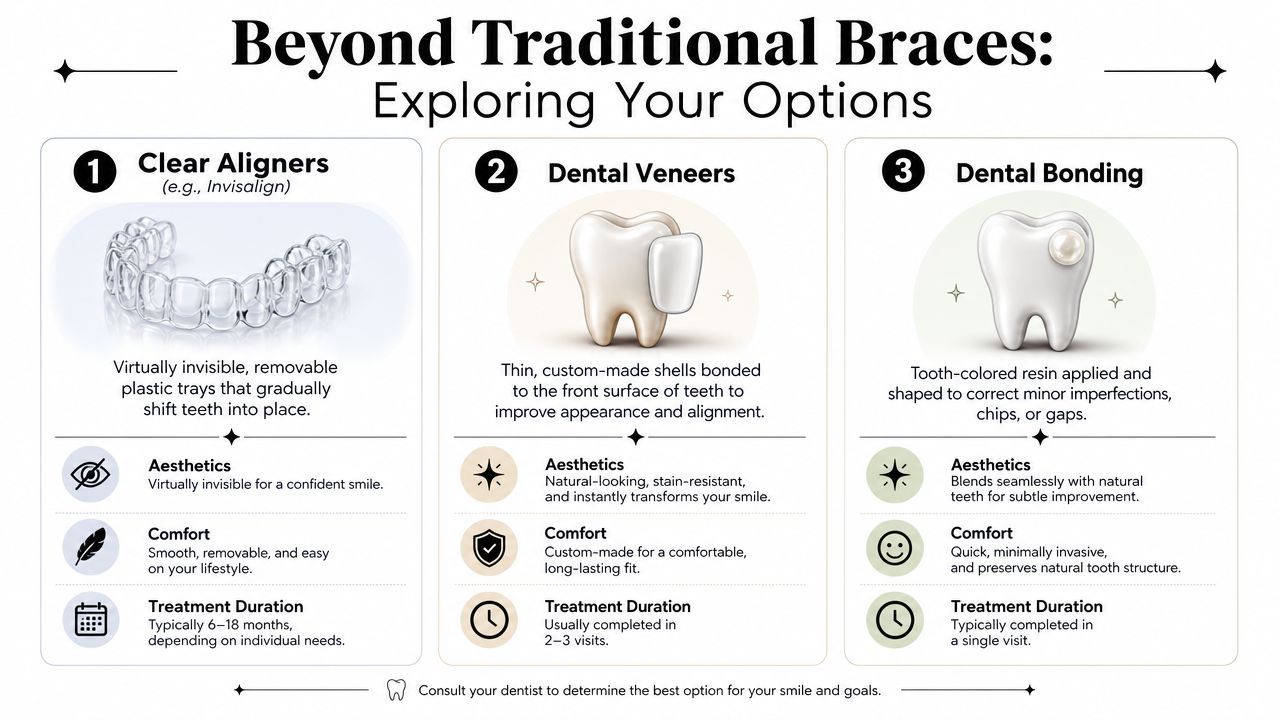
Some non-braces treatments move teeth. Others change what you see when you smile. Knowing which category a treatment falls into can save you time, money, and frustration.
To make the choices easier to understand, here's a side-by-side visual.
Clear aligners
Clear aligners are the most established braces-free way to move teeth rather than just cover their appearance. Invisalign states that treatment can be used after the adult teeth come in and is typically suited to mild to moderate alignment issues. The company also describes it as “the best and fastest way to straighten teeth without braces,” and the same page notes that many straightforward cases are often discussed in a treatment range of about 6 to 18 months on Invisalign's straighter teeth resource.
That matters because clear aligners are removable, nearly invisible, and compatible with normal eating and brushing. For adults who want real tooth movement without brackets, they're often the first option worth discussing.
Patients who want a closer look at this approach can also review Invisalign treatment at our Cornelius office.
Here's the practical fit for aligners:
| Option | What it does | Best for | Main trade-off |
|---|---|---|---|
| Clear aligners | Moves teeth gradually | Mild to moderate crowding, spacing, and some alignment issues | Requires consistent wear and patience |
A short overview can help if you want to see the concept in action.
Porcelain veneers
Veneers do not move teeth. They are thin shells placed on the front surfaces of teeth to improve how they look. For the right patient, veneers can make a smile appear straighter by changing visible shape, width, proportion, and symmetry.
They can make sense when the concern is mostly cosmetic. For example, a person may have a slight rotation, uneven front teeth, or small spaces that show when they smile. In that setting, veneers can create a more balanced appearance.
Veneers are usually a better fit when:
- The bite is already stable
- The alignment issue is mild in appearance
- The patient wants a cosmetic change rather than orthodontic movement
- The smile concerns include shape or color as well as crookedness
Dental bonding
Bonding is another cosmetic approach, not an orthodontic one. A tooth-colored resin is applied and shaped to improve small imperfections. It's often a practical option when the change needed is minor and targeted.
Bonding is useful for:
- Small gaps
- Slightly uneven edges
- Minor asymmetry
- A tooth that looks a little out of line because of its shape
Compared with veneers, bonding is often the more conservative way to improve one small area quickly.
Cosmetic treatments can make a smile look straighter. They don't reposition roots or correct the underlying tooth alignment.
Crowns and enamel contouring
Sometimes the conversation includes treatments that aren't primarily about straightening, but still affect the final appearance.
Crowns may come into play when a tooth is misshapen, heavily restored, or structurally weakened. In those cases, restoring strength may be just as important as improving the smile line.
Enamel contouring involves subtle reshaping of tooth edges or surfaces. It can help when a tooth looks uneven because of extra enamel or a small irregular edge. This is a very selective treatment. It's for fine tuning, not major correction.
The simplest way to think about your choices
If you're trying to understand how to fix crooked teeth without braces, this is the cleanest framework:
- Need teeth moved? Clear aligners are usually the main braces-free option.
- Need teeth to look straighter? Veneers or bonding may be appropriate for mild cosmetic concerns.
- Need one tooth restored or refined? A crown or contouring may be part of the answer.
The right choice depends less on what sounds fastest and more on what your teeth need.
Are You a Good Candidate for Non-Braces Treatment
Not everyone with crooked teeth needs the same solution. The deciding factors are usually the severity of the misalignment, whether there's a bite issue, and the condition of your teeth and gums.
Mild cosmetic issue or true alignment problem
This is the first decision point. Some smiles have a tooth that only appears crooked because of shape, edge wear, or a small space nearby. Other smiles have actual crowding, rotation, or tooth position problems that need movement.
For slight crookedness or small gaps, a practical non-braces workflow is often cosmetic or limited orthodontic correction. A dentist first confirms that the case is mild enough for non-extractive treatment, then may use dental bonding or porcelain veneers to mask asymmetry. Bonding is typically a single-visit procedure, and veneers are thin front-facing shells. Neither moves teeth, but both can make a smile appear straighter, as explained in Springview Dental's overview of fixing crooked teeth without braces.
That means a good candidate for cosmetic correction usually has a problem that is small, visible, and mainly aesthetic.
Questions that help sort it out
If you're trying to judge your own situation before a consultation, these questions are useful:
- Do your teeth feel crowded or does one just look uneven from the front?
- Does your bite feel comfortable when you chew and close your teeth together?
- Are your gums healthy, or do you have bleeding, tenderness, or recession that needs attention first?
- Do you want the fastest visual improvement, or the most conservative long-term correction?
Your answers don't replace an exam, but they do point the conversation in the right direction.
Cosmetic masking versus orthodontic movement
Here's where patients often need the clearest advice.
| Path | What it changes | Good fit | Limitation |
|---|---|---|---|
| Cosmetic masking | The visible look of the teeth | Slight crookedness, minor gaps, shape concerns | Doesn't move teeth |
| Orthodontic movement | The position of the teeth | Mild to moderate alignment issues | Takes time and compliance |
The right answer depends on your goal. If you want actual alignment correction, cosmetic dentistry won't substitute for tooth movement. If your teeth function well and the issue is small, cosmetic treatment may be the simpler answer.
If a treatment only changes the surface appearance, it should be chosen for appearance-based problems, not for deeper bite or alignment problems.
When non-braces treatment may not be enough
There are also times when the most honest recommendation is that a patient may need traditional orthodontic care. Severe crowding, significant bite discrepancies, or cases where tooth movement has to be tightly controlled may not be ideal for cosmetic camouflage or limited aligner treatment.
That doesn't mean you've failed to qualify. It means the diagnosis matters more than the trend. A treatment should protect your long-term oral health, not just create a short-term visual improvement.
Patients usually appreciate direct guidance here. If your case is mild, non-braces treatment may work very well. If your case is more complex, hearing that early prevents disappointment and helps you make a healthier choice.
The Path to Your Straighter Smile at Our Cornelius Office
The process feels much easier when you know what to expect. Most patients relax once they see that this isn't a mystery. It's a sequence of manageable steps, with decisions made carefully at each stage.
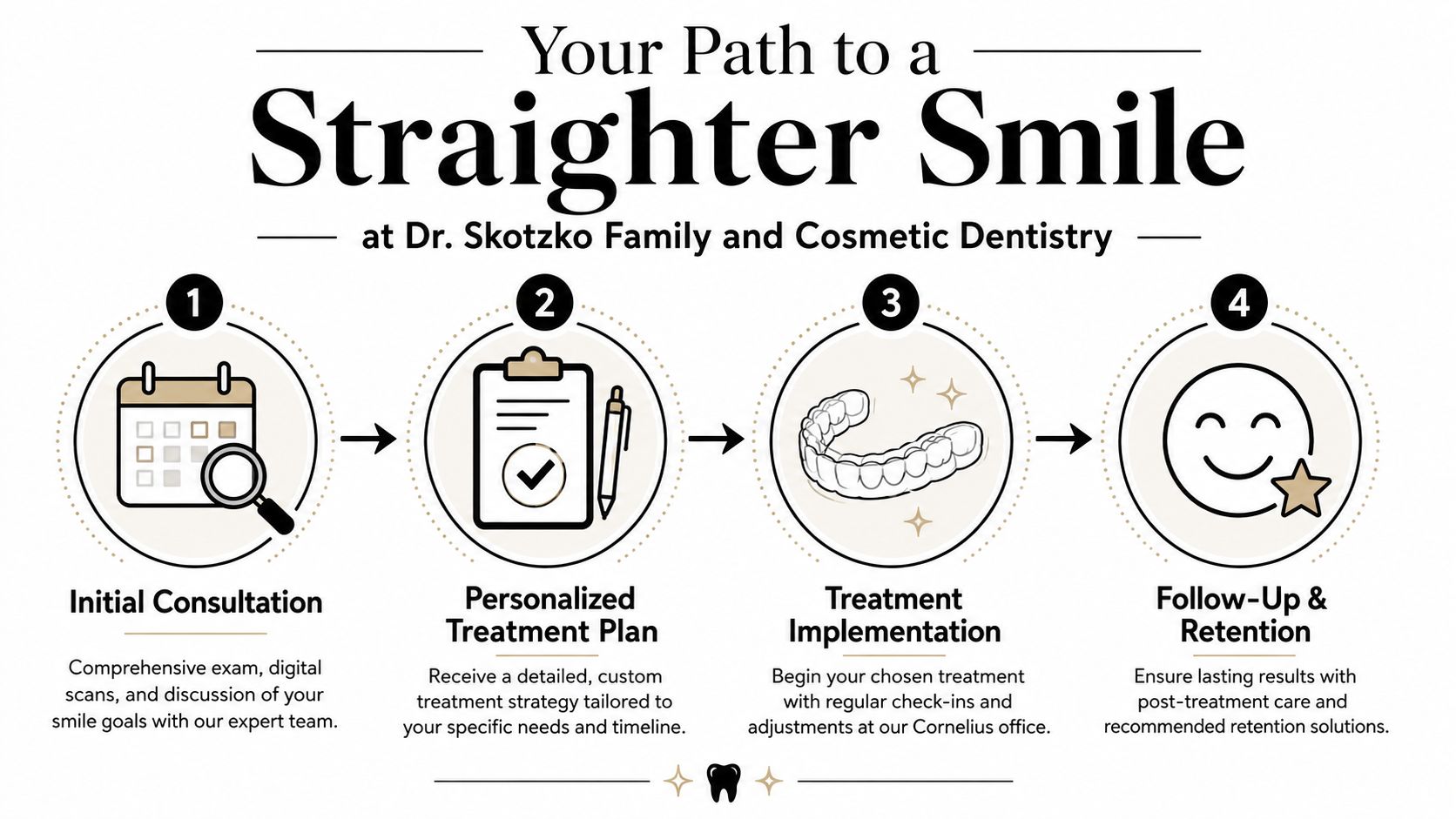
Your first visit
A new patient who asks about crooked teeth usually starts with a conversation, not a commitment. We look at the teeth, the gums, the bite, and the smile from a functional and cosmetic standpoint. The question isn't just “Can we make this look better?” It's also “What's the healthiest way to do it?”
This first visit may include diagnostic records and a closer review of whether the concern is best handled with aligners, bonding, veneers, contouring, or restorative treatment. Some cases are straightforward. Others need a little more planning.
Building the treatment plan
Once the problem is clear, the next step is choosing the right category of treatment. A patient with mild spacing and good bite support may move forward with aligners. Someone with a small visible irregularity and otherwise stable teeth may be better served by bonding or veneers.
This is also where lifestyle matters. A busy adult who wants removable treatment may prefer aligners. Another patient may want the fastest cosmetic improvement and be comfortable with restoration-based care.
A useful treatment plan should answer four questions:
- What are we correcting
- Are we moving teeth or improving appearance
- What will daily life look like during treatment
- What kind of maintenance will the result require later
What treatment feels like in real life
Different treatments unfold in different ways.
For clear aligners, treatment usually involves receiving a series of trays and wearing them as instructed, with check-ins to monitor progress. For bonding, the improvement may happen in a single visit when the resin is placed and shaped. For veneers, treatment involves planning, preparation, and placement over a sequence of visits.
Most anxiety comes from uncertainty. Once patients know the steps, the process usually feels much more manageable.
At Skotzko Family Dental Clinic, patients can discuss these options in the context of general, cosmetic, and restorative care rather than trying to piece together separate recommendations on their own.
Follow-up and keeping the result
The final stage isn't just the reveal. It's keeping the result stable and comfortable. Teeth, restorations, and bite forces all need ongoing attention. Follow-up visits help confirm that the appearance still matches healthy function.
That long-view mindset matters. A straighter smile should still be easy to maintain, comfortable to use, and appropriate for your habits. Whether the treatment involved movement or cosmetic change, the best outcomes come from planning that respects both appearance and oral health.
The Health and Confidence Benefits of a Straighter Smile
People often start this process because they want a nicer smile. That's a completely valid reason. But the benefits usually reach further than appearance alone.

Easier cleaning and healthier habits
When teeth are straighter and more evenly positioned, they're generally easier to brush and floss well. That matters because hard-to-reach overlaps and tight crowding can make home care more frustrating. Patients often notice that once alignment or visible irregularities are improved, their daily routine feels more manageable.
A good result should support oral hygiene, not complicate it. That's one reason treatment planning has to go beyond looks.
Better balance across the smile
Crooked teeth can also create uneven contact patterns. One tooth may take more force than it should. Edges may wear in ways that don't match the rest of the smile. Sometimes a patient doesn't notice this at first because the concern began as a cosmetic one.
Improving alignment or correcting the visible shape of teeth can help create a smile that looks more harmonious and functions more comfortably. The exact benefit depends on the starting problem, which is why diagnosis comes first.
Fast results versus lasting simplicity
The long-term trade-off deserves real attention. Restoration-based options like veneers and bonding may require replacement or touch-ups over time, unlike the permanent change from orthodontic movement, as discussed in Botsford Dental's review of braces-free straightening options.
That doesn't make cosmetic treatment a poor choice. It just means the maintenance question should be part of the decision from day one.
Here's the practical comparison:
- Orthodontic movement offers a change in actual tooth position
- Bonding and veneers can improve appearance more quickly
- Restoration-based treatment may involve future upkeep
- The right option depends on whether you value speed, conservation, longevity, or a mix of all three
Confidence is part of oral health too
The emotional side matters. When people feel good about their smile, they often smile more naturally, speak more comfortably, and stop focusing on the feature that's been bothering them for years.
That doesn't mean every patient wants a dramatic makeover. Many just want one distracting detail corrected so they can stop thinking about it. That's a meaningful outcome.
A successful smile treatment doesn't just look better. It feels easier to live with every day.
Why Cornelius Families Trust Dr. Skotzko for Smile Makeovers
Choosing how to fix crooked teeth without braces isn't only about the treatment itself. It's also about who is guiding the decision. Patients need clear explanations, realistic expectations, and a setting where they don't feel rushed into the wrong option.
A long-term dental home
Dr. Skotzko Family and Cosmetic Dentistry has served Cornelius since 1998, providing general, family, cosmetic, and restorative care for patients who want continuity, not one-time treatment. That long-term model matters when a smile decision involves maintenance, follow-up, and future oral health planning.
For patients in Cornelius and nearby communities, it's helpful to have one office that can look at the full picture. Crooked teeth may involve cosmetic goals, but they can also intersect with bite comfort, restorations, gum health, and routine care.
A patient-first conversation
Patients often come in expecting a sales pitch for one specific product. What they need is a diagnosis and a discussion of trade-offs. Some smiles are good candidates for aligners. Some are better served by bonding or veneers. Some need more conservative advice.
That kind of honesty builds trust. It also protects patients from choosing the fastest-looking option when a different path would make more sense over time.
You can learn more about the practice background and approach on the Dr. Daniel Skotzko profile page.
Comfort matters when people feel nervous
A lot of adults who ask about smile improvements also feel anxious about dental treatment in general. They may not be worried only about appearance. They may be worried about discomfort, the unknown, or whether they'll understand what's happening.
That's why a pain-conscious, education-focused approach matters. When patients understand their options and know what to expect, they usually feel more confident making a decision.
A strong local dental relationship should include:
- Clear guidance about what will work and what won't
- Respect for comfort during cosmetic and restorative care
- Attention to maintenance after treatment is complete
- A practical plan that fits family life in Cornelius
For many patients, trust doesn't come from hearing that every case is easy. It comes from hearing the truth in a calm, understandable way.
Take the First Step Toward Your New Smile Today
If you've been putting this off because you don't want braces, there may be more options than you think. Clear aligners can move teeth in the right cases. Veneers and bonding can improve the look of mild crookedness. Some smiles need subtle reshaping or restorative care instead.
The important part is choosing the treatment that matches the underlying problem. A fast cosmetic fix can be the right answer for one person and the wrong answer for another. The difference comes down to your bite, your oral health, your goals, and how much maintenance you're comfortable with later.
If you're in Cornelius, NC, and you've been searching for a dentist near me to discuss crooked teeth openly, the next step doesn't have to feel complicated. Start with a consultation. Ask whether your teeth need to be moved or reshaped. Ask what will look natural. Ask what will last.
Patients from Cornelius and nearby communities such as Huntersville and Davidson often feel better once they have a clear plan. Even if you're not ready to begin treatment right away, understanding your options can remove a lot of uncertainty.
A straighter smile without traditional braces is often possible. The best path is personal.
If you're ready to explore your options, schedule a consultation with Skotzko Family Dental Clinic. The team can help you understand whether clear aligners, bonding, veneers, or another approach makes the most sense for your smile, your health, and your long-term goals.